



Your content can look solid and still miss what your audience is searching for. When that happens, traffic stalls, rankings slip, and competitors pick up the clicks you should be getting.
A content gap analysis fixes this by showing you exactly where your site falls short and what to create next. This guide walks you through how to do a content gap analysis step by step, so your content works harder and ranks where it should.
Quick Summary: How to do a Content Gap Analysis
A content gap analysis is the process of finding topics your audience wants to know about, but you haven’t covered yet. This analysis helps you find new topics, improve existing content, and get more traffic.
Follow these steps:
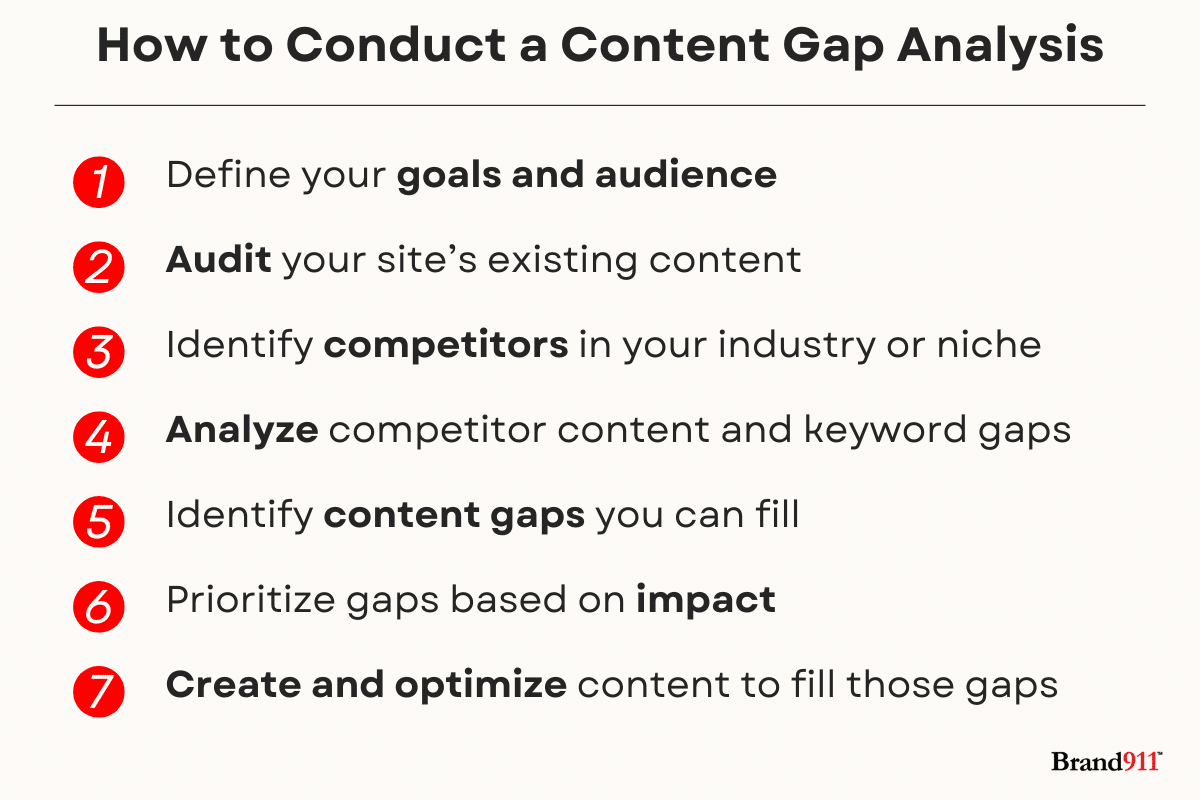
- Define your goals and audience
- Audit your site’s existing content
- Identify competitors in your industry or niche
- Analyze competitor content and keyword gaps
- Identify content gaps you can fill
- Prioritize gaps based on impact
- Create and optimize content to fill those gaps
What is a Content Gap Analysis?
A content gap analysis is the process of finding topics and questions your audience is searching for that your site does not answer. It shows the space between what you publish and what people actually want to know.
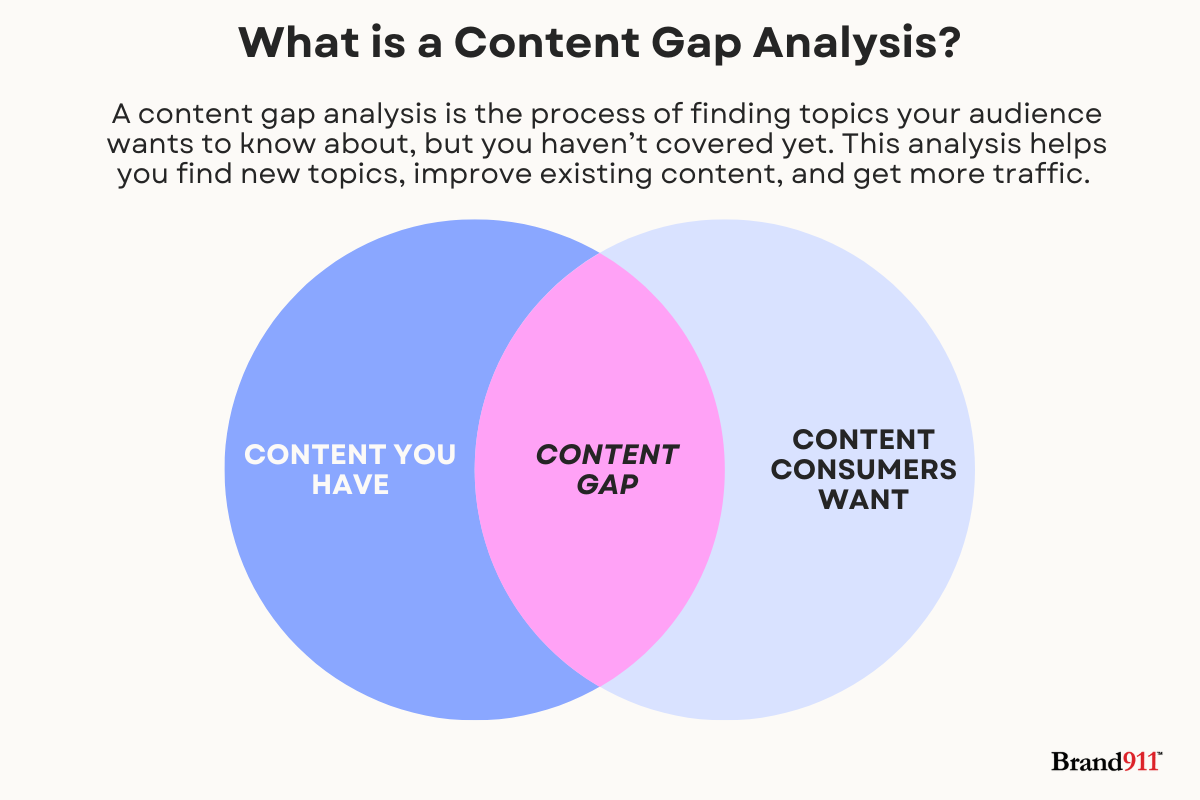
Every gap is a missed chance to earn traffic, trust, and rankings.
When you cover a topic fully, Google sees your site as more credible on that subject. That helps your pages rank higher and brings in more qualified traffic.
A strong content gap analysis helps you:
- Rank for keywords you are currently missing
- Improve the experience for visitors who want clear answers
- Build trust by addressing real needs instead of guessing
- Keep users on your site instead of sending them to competitors
If your site does not answer a question, someone else’s site will. That is how traffic leaks happen.
Content gaps are not only missing topics. They also include:
- Outdated posts that no longer reflect current search intent
- Thin pages that only skim the surface
- Guides that should be deeper, clearer, or more practical
Fixing these gaps turns your content from “good enough” into content that actually competes.
7 Steps to do a Content Gap Analysis
1. Define Your Goals and Audience
A content gap analysis should start with a clear purpose.
Before you look at keywords or competitors, decide what you want your content to achieve. That might be ranking for core topics, supporting lead generation, or building authority around a specific service.
Set goals you can measure, such as improving rankings for a topic cluster or increasing qualified traffic to key pages. Write those goals down so you can judge progress later.
Once your goals are clear, shift your focus to your audience. Content gaps exist because audience questions go unanswered.
Think about:
- What problems your audience is trying to solve
- What questions keep coming up during research or decision-making
- Where they are in the buying or decision process
Building simple buyer profiles helps here. You do not need anything complex. You just need to understand who they are, what they care about, and what kind of information helps them move forward.
Pay close attention to search intent. High search volume means very little if the content does not match what the searcher expects. Traffic that does not convert usually comes from intent mismatch, not poor writing.
To uncover real questions, look beyond keyword tools. Social listening platforms like Sprout Social, HubSpot, and Hootsuite can show what people are actively discussing. Reddit threads and niche forums often reveal questions people ask when they are stuck or confused. Tools like AnswerThePublic surface the exact phrases and questions people type into search engines.
When your goals are defined and your audience is understood, your content gap analysis stops being a list of keywords and starts becoming a plan that actually drives results.
2. Audit Your Site’s Existing Content
Before looking outward, start with what you already have. Your site often contains more opportunities than you realize.
Begin by taking inventory of all published content. This includes blog posts, guides, service pages, and resource articles. The goal is to see the full picture, not just your most recent or best-performing pages.
Once everything is listed, review performance.
Look for content that:
- Ranks well and drives steady traffic
- Ranks on page two or three and could improve with updates
- Gets impressions but few clicks
- Has lost traffic over time
- Covers the same topic as another page on your site
Underperforming pages often signal content gaps. The topic may be right, but the depth, structure, or intent may be off. Overlapping pages can also weaken rankings by competing against each other instead of working together.
This step helps you spot quick wins. Updating or consolidating existing content is often faster and more effective than creating something new from scratch.
By understanding what you already have, you avoid duplicating effort and make smarter decisions when filling content gaps later.
3. Identify Competitors in Your Industry or Niche
For a content gap analysis, your competitors are not always the brands you admire or do business with. They are the sites that already rank for the keywords you want to own.
Start by searching your target topics in Google. Pay attention to which domains consistently appear on page one. These are your real competitors from a search perspective, even if they operate differently from your business.
Focus on:
- Sites ranking for your core keywords
- Blogs or resource hubs covering your target topics
- Publishers or niche sites answering the same questions as you
This step matters because content gaps are relative. A topic is only a gap if someone else is already meeting that need better than you are.
Limit your list to a manageable group. Three to five competitors is usually enough to reveal patterns without overwhelming the analysis.
When you know who you are actually competing against in search results, the rest of the content gap analysis becomes far more accurate and actionable.
4. Analyze Competitor Content and Keyword Gaps
Once you know who your real competitors are, the next step is understanding why they outrank you. This is where content gap analysis starts producing clear direction.
Focus on three to five competitors who consistently rank for your core keywords. Use keyword gap tools from platforms like Ahrefs, Semrush, or Google Keyword Planner to see which terms they rank for that you do not. These keywords highlight topics your audience is already engaging with elsewhere.
The goal is not to copy competitor content.
It is to understand what is working and where you can do better.
For each important keyword, review the top-ranking pages and look closely at:
- The topics they cover that you have not addressed
- How deep their content goes compared to yours
- The format they use, such as guides, lists, videos, or visuals
- Whether their content clearly matches search intent
This kind of review highlights where SEO-friendly blogging best practices can give your content a competitive edge.
Pay attention to long-tail keywords during this step. They often have lower competition and attract users who are closer to taking action. These keywords may bring less traffic individually, but they tend to convert better and are easier to win.
Also look for media gaps. If competitors support their content with visuals, charts, or videos and your pages are text-only, that is a clear opportunity to improve both rankings and user experience.
This step reveals where competitors are meeting audience needs more effectively than you are and shows exactly where your content can step in and compete.
5. Identify Content Gaps You Can Fill
At this point, you should have a clear view of what exists on your site and what competitors are doing better. Now it is time to identify the gaps you can realistically fill.
Content gaps usually fall into a few clear categories.
- Missing topics. These are subjects your audience searches for that you have not covered at all. If competitors rank for these topics and they align with your goals, they represent direct opportunities.
- Shallow coverage. You may have content on a topic, but it only scratches the surface. This often shows up as short posts ranking poorly while longer, more thorough competitor pages dominate search results. In these cases, the gap is depth, not topic.
- Search intent mismatches. If someone is looking for a step-by-step guide and lands on a high-level overview, your content will not satisfy them. Rankings suffer when the format, angle, or detail level does not match what searchers expect.
Not every gap is worth filling. Focus on the ones that:
- Match your expertise and offerings
- Align with what your audience actually needs
- Give you a clear way to improve on what already exists
Identifying the right gaps keeps your efforts focused and prevents you from creating content that never gains traction.
6. Prioritize Gaps Based on Impact
After identifying your content gaps, the next step is deciding which ones to tackle first. You cannot fill every gap at once, so prioritization matters.
Start by grouping your gaps into clear categories. This helps you see patterns and avoid chasing isolated ideas.
Common gap types include:
- Keyword gaps where competitors rank and you do not
- Topic gaps where entire subjects are missing
- Media gaps where formats like video or visuals are absent
- Content quality gaps such as outdated, thin, or hard-to-use pages
Once organized, evaluate each gap based on impact:
- Search demand and competition: Keywords with strong demand and lower competition often deliver faster results. These are good short-term targets.
- Business relevance and value: A keyword with less volume may still be valuable if it attracts the right audience or supports a key service. Traffic that aligns with your goals is more useful than traffic that does not convert.
- Funnel stage: Consider where each gap fits in the buyer journey. A strong content strategy supports awareness, consideration, and decision-making. If your site only targets top-of-funnel topics, gaps further down the funnel may deserve priority.
Balance quick wins with longer-term opportunities. Filling easier gaps builds momentum, while more competitive topics support sustained growth over time.
7. Create and Optimize Content to Fill Those Gaps
Once you know which gaps to focus on, execution becomes the priority. This is where research turns into results.
Start by matching search intent. Look at the top-ranking pages for your target topic and identify what users expect to see. Are they looking for a guide, a comparison, a checklist, or an answer to a specific question? If your content does not match that intent, it will struggle to rank no matter how well written it is.
Next, improve depth and clarity. Cover the topic more completely than what already exists. That does not mean adding filler. It means answering follow-up questions, addressing common objections, and explaining the process in a way that actually helps the reader.
Structure also matters. Clear headings, logical sections, and scannable formatting help both users and search engines understand your content. Strong structure increases time on page and makes it easier for search engines to see the value of your page.
When possible, update existing content instead of starting from scratch. Expanding, refreshing, or restructuring a page that already has traction is often faster and more effective than publishing something new.
Filling content gaps works best when your content is built for people first and search engines second. When those two align, rankings tend to follow.
How to Track the Success of a Content Gap Analysis
A content gap analysis only matters if it leads to measurable improvement. Tracking the right metrics helps you see what is working and where adjustments are needed.
- Keyword Rankings: Use Google Search Console to monitor whether your pages are moving up for the terms you targeted. Steady improvement is a strong signal that your content matches search intent and fills a real gap.
- Organic Traffic: Google Analytics shows whether new or updated pages are attracting more visitors from search. Rising traffic usually means your content is answering questions your audience is actively searching for.
- Engagement Metrics: Time on page and bounce rate help you understand how people interact with your content. Higher engagement suggests readers are finding value and staying to read, not clicking back to search results.
- Conversions: Measure leads, inquiries, or sales tied to the pages you updated or created. Traffic alone does not equal success. Measure leads, inquiries, or sales tied to the pages you updated or created.
Review these metrics regularly so your content gap analysis continues to guide smarter decisions.
Tracking these metrics consistently is key to increasing blog traffic without relying on guesswork.
What Are the Different Types of Content Gaps?
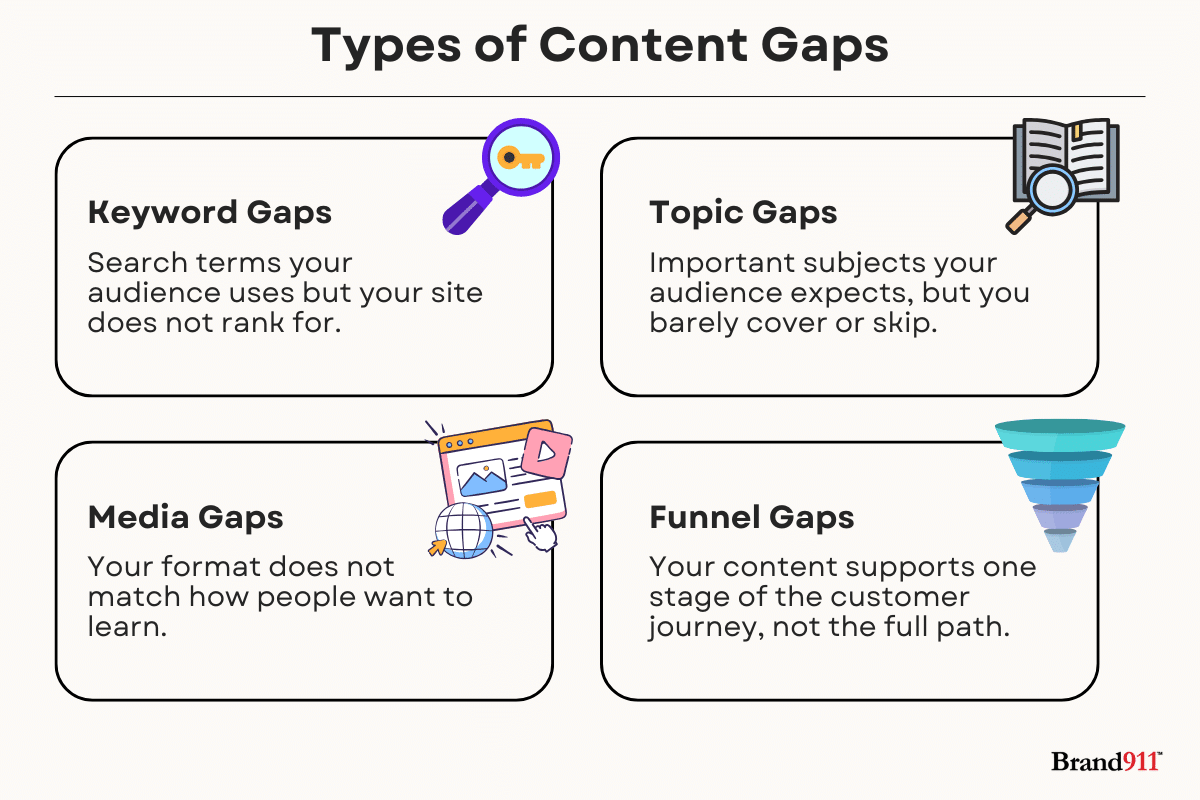
- Keyword Gaps: Search terms your competitors rank for that you do not. Keyword research tools make these gaps easy to spot, especially when competitors consistently appear on page one for topics you have not targeted.
- Topic Gaps: Entire subjects or important subtopics your audience expects you to cover, but your site barely touches or ignores completely. Topic gaps often show up when competitors publish comprehensive guides and your site only offers scattered mentions.
- Media Gaps: Your content format does not match audience preferences. If competitors support their pages with videos, visuals, or diagrams and your content is text-only, you may be missing engagement and conversion opportunities.
- Funnel Gaps: Your content is missing at a specific stage of the buyer journey. You may have strong awareness content but nothing that supports comparison or decision-making. A complete content gap analysis looks at whether each stage is supported, not just whether topics exist.
Content Gap Analysis for AI Search
AI search changes how content is discovered, summarized, and cited. A content gap analysis needs to account for how AI systems choose sources, not just how pages rank.
Focus on Natural Language Prompts
AI Overviews and conversational search rely on full questions, not short keywords. Your analysis should include the phrases people actually type or speak.
Look for:
- Complete questions and follow-ups
- Problem-based searches
- “How,” “why,” and “best way” queries
These prompts signal what AI systems are trying to answer.
Build Credibility with E-E-A-T
AI does not pull from thin content. It favors pages that show real knowledge and trust.
Strong signals include:
- First-hand experience or clear subject expertise
- Claims supported by data or examples
- Clear explanations that go beyond surface-level definitions
This is why understanding E-E-A-T SEO and why it matters is critical when filling content gaps.
Answer Questions Directly and Completely
AI prefers clarity. If a question can be answered in a few sentences, do it early. Then expand with supporting detail.
Effective AI-friendly content:
- Addresses the main question right away
- Covers related follow-up questions
- Uses clear structure and headings
Optimize for AI Visibility
Content that appears in AI Overviews is often well-structured and authoritative. Your content gap analysis should identify where your site lacks this level of clarity or depth.
When your content is easy to understand, clearly structured, and credible, it becomes more likely to be referenced in AI-driven search results.
Mistakes to Avoid During a Content Gap Analysis
A content gap analysis is only useful if it leads to effective results and more streamlined decision-making about your content.
These common mistakes can undo the work fast.
- Ignoring search intent: Chasing high-volume keywords without understanding intent leads to poor results. A query like “best CRM software” needs comparisons and evaluations, not a basic definition.
- Focusing only on keywords: Keywords matter, but they are not the goal. Content should be helpful, clear, and written for real questions. Keyword-heavy pages that lack substance rarely perform well.
- Neglecting competitor insights: Competitor content shows you what already works. Skipping this step means missing patterns, formats, and angles that searchers respond to.
- Failing to prioritize: Trying to fill every gap at once leads to stalled execution. Focus on gaps with the highest impact first to keep progress moving.
- Blindly copying competitors: Mirroring competitor content without adding value will not set you apart. Your content needs a clearer angle, better depth, or stronger examples to compete.
- Overlooking your own content: Many of the fastest wins come from updating existing pages. Refreshing, expanding, or restructuring content often delivers results faster than creating something new.
How Often Should You Perform a Content Gap Analysis?
To stay competitive, you should perform regular content analyses–monthly, quarterly, and annually.
A content gap analysis is not a one-time project. Search behavior changes, competitors publish new content, and algorithms shift throughout the year.
- Annually: Run a full, in-depth content gap analysis. This gives you a clear picture of your overall content landscape, major weaknesses, and long-term opportunities.
- Quarterly: Review your strategy and existing gaps. Quarterly check-ins help you adjust priorities, respond to ranking changes, and catch emerging topics before they become competitive.
- Monthly: In fast-moving industries, scan for new opportunities every month. This can include new questions showing up in search results, competitor content launches, or changes in user intent.
Treating content gap analysis as an ongoing process keeps your content aligned with what your audience and search engines expect, not what worked months ago.
Conclusion
A content gap analysis helps you create content with purpose instead of guessing what might work. As search behavior and competition change, checking for gaps regularly keeps your strategy relevant and effective.
This is the same process we use at Brand911 to guide content decisions that drive rankings, traffic, and leads. The real impact comes from execution, not just identifying opportunities, which is why a strong content marketing for SEO strategy matters just as much as the analysis itself.
If you need help turning gaps into results, our content marketing services handle the full process from research to performance tracking.
Key Takeaways
- Content gaps show where your site can compete
- Search intent matters more than volume
- Existing content often holds the fastest wins
Ready to build content that works harder? Learn more about our content marketing services and see how Brand911 can help.
Frequently Asked Questions (FAQs) About Content Gap Analysis
What tools are best for a content gap analysis?
You do not need a large tool stack to get value. Most content gap analyses use a mix of one SEO platform and first-party data.
SEO tools like Ahrefs or Semrush help identify keyword and ranking gaps between your site and competitors. Google Search Console is essential for spotting queries where your pages get impressions but few clicks. Tools like AnswerThePublic surface real questions people ask, which is useful for finding gaps AI tools may miss.
How is a content gap analysis different from keyword research?
Keyword research focuses on individual terms. A content gap analysis looks at the full picture.
It considers missing topics, weak coverage, intent mismatches, and format issues. Two pages can target the same keyword, but one wins because it answers the question more completely. Content gap analysis explains why.
How long does it take to see results after filling content gaps?
Results depend on the type of gap and competition. Updates to existing pages often show movement within weeks. New content usually takes longer, especially in competitive spaces.
Ranking improvements, engagement changes, and assisted conversions are often visible before major traffic growth.
Can content gap analysis improve visibility in AI search results?
Yes, when done correctly. AI search systems favor content that answers questions clearly and demonstrates subject understanding.
Content gap analysis helps you identify unanswered questions, missing context, and weak explanations. Filling those gaps increases the chance your content is selected as a reference source in AI-generated answers.
How do I know which content gaps are worth fixing first?
Focus on impact, not volume. The best gaps align with your expertise, support business goals, and match clear search intent.
Gaps tied to existing pages or bottom-of-funnel topics often deliver faster returns than broad, high-competition topics.
Who should be responsible for content gap analysis?
Content gap analysis works best when SEO, content, and business goals are aligned. In small teams, one person may handle it. In larger teams, collaboration leads to better decisions.
What matters most is consistency. Regular analysis prevents content drift and keeps your site competitive as search behavior changes.
About us and this blog
We are a digital marketing company with a focus on helping our customers achieve great results across several key areas.
Request a free quote
We offer professional SEO services that help websites increase their organic search score drastically in order to compete for the highest rankings even when it comes to highly competitive keywords.
Subscribe to our newsletter!
More from our blog
See all posts





Recent Posts
- What is an SEO Strategy? January 8, 2026
- What Is Digital PR? A Practical Guide to Building Trust Online January 6, 2026
- How to Do a Content Gap Analysis December 30, 2025


Recent Comments