



Most businesses know they should be doing SEO, yet their content still doesn’t rank or bring in leads.
They publish blog posts, tweak keywords, and wait—only to see little or no organic traffic.
That frustration usually comes from not understanding what SEO content actually is or how it’s supposed to work.
This guide breaks it down in plain terms so you can see what matters, what doesn’t, and how to create content that gets found.
Quick Answer
SEO content is content created to rank in search engines by targeting what people search for and answering those questions clearly. It’s built around keywords, search intent, and structure so Google can understand it and users want to click it. SEO content earns visibility and traffic without relying on paid ads.
Contents:
- What Makes Content “SEO Content”?
- Examples of SEO Content
- Key SEO Terms
- The Importance of SEO Content
- 3 Key Factors Google Rewards
- The Reason DIY SEO Content Struggles to Rank
- Steps to Create SEO Content that Ranks
- SEO Content Checklist
- How Long Does SEO Content Take to Work
- Conclusion
- FAQs
What Makes Content “SEO Content” (Not Just Content)
Not all content is meant to rank. Content marketing for SEO means content is created with search demand and business results in mind.
Here’s what sets it apart.
- Targets search demand. SEO content is built around a keyword people actually search for. If no one searches for it, it won’t drive organic traffic.
- Matches search intent. It answers what the searcher wants to do: learn, compare, buy, or find a local option.
- Uses clear structure. Headings, short sections, and internal links help readers scan and help Google understand the page.
- Supports a business goal. Every page should lead somewhere, like a call, a form fill, a booking, or a next step.
Regular Content vs SEO Content:
| Regular Content | SEO Content |
| Written for engagement for updates | Written to rank and convert |
| No keyword focus | Built around a clear keyword |
| Assumes context | Explains and answers questions directly |
| No clear next step | Tied to leads, sales, or actions |
Examples of SEO Content (With Real Business Use Cases)
SEO content shows up in many formats. The key is choosing the type that matches what people are actually searching for.
Here are the most common examples, with practical use cases.
| SEO Content Type | What It’s Used For | Example | Primary Business Benefit |
| Blog Posts | Answer long-tail keywords and common questions | “How much does professional website design cost?” | Education and early-stage traffic |
| Service Pages | Target high-intent searches for what you offer | “SEO services for small businesses in Chicago” | Leads and inquiries |
| Product pages | Capture buyers ready to act | “Noise-canceling headphones for remote work” | Direct sales |
| Comparison pages | Help users choose between options | “Webflow vs WordPress for small businesses” | High conversion potential |
| Local pages | Match local intent and “near me” searches | “SEO consultant near me” | Visibility in local searches |
| Videos | Rank in video and blended search results | “How to improve SEO content in 10 minutes” | Engagement and reach |
| Images | Appear in image search results | “seo-content-outline-example.jpg” | Accessibility and relevance |
| Glossary pages | Capture beginner definition searches | “What is search intent?” | Authority and internal links |
Which type should you start with?
Start with service pages. These are your money pages and tie directly to leads or sales.
Once those are solid, use SEO-friendly blog content to support them. Blogs answer questions, target long-tail keywords, and feed traffic into your core pages.
Key SEO Terms You’ll See
These are common SEO terms you’ll see used throughout this post and in most SEO conversations. You don’t need to memorize them, just understand how they fit together.
- Keyword: The word or phrase people type into Google. SEO content is built around one primary keyword.
- Long-tail keyword: A longer, more specific search query. These are often easier to rank for and attract more qualified visitors.
- Search intent: What the searcher wants to do. Learn, compare, buy, or find something local.
- SERP: The search engine results page. This is the list of results Google shows after a search.
- Title tag: The clickable headline that appears in the SERP and in the browser tab.
- Meta description: The short preview text under the title tag. It helps convince users to click.
- H1 / H2 / H3: Page headings and subheadings. They organize content for readers and help Google understand structure.
- URL slug: The end of a page’s web address. It should be short, clear, and descriptive.
- Internal link: A link from one page on your site to another. It helps users navigate and spreads relevance.
- Backlink: A link from another website to yours. Backlinks act as credibility signals.
- Organic traffic: Visits that come from unpaid search results, not ads.
- Schema: Structured data that helps Google understand page elements and display rich results.
Why SEO Content Matters for Businesses Doing DIY SEO
If you’re handling SEO yourself, effort alone isn’t the problem.
Direction usually is.
SEO content helps your business show up on the right search engine results pages (SERPs), not just exist online.
Here’s what it actually does for you.
- Visibility: SEO content puts your pages in front of people who are already searching. When your content matches real searches, you earn visibility where it matters.
- Trust: Clear, helpful pages build confidence before someone contacts you. Ranking on the SERP signals credibility, even before a visitor reads a word.
- Compounding organic traffic. Good SEO content keeps driving organic traffic long after it’s published. One strong page can outperform dozens of short posts over time.
The reality check:
Publishing more pages won’t fix SEO.
Without a clear keyword strategy and intent match, content just adds noise.
SEO content works when each page has a purpose, a target search, and a role in your overall site.
If you’re newer to SEO and still learning how all the pieces fit together, reviewing SEO basics for beginners can help clarify where content fits into the bigger picture.
The 3 Things Google Rewards (A Simple Framework)
You don’t need to chase hundreds of ranking factors to create SEO content that works.
Google consistently rewards three things.
Relevance
Your content must match the keyword and the search intent behind it.
If someone is looking to compare options and you give them a sales pitch, the page won’t perform.
Quality
Your page should answer the question better than other results on the SERP.
That means clear explanations, complete coverage, and information people don’t need to look up elsewhere.
Credibility
Your site needs to look trustworthy.
This comes from real experience, accurate information, clear authorship, and backlinks from relevant sites.
In plain terms, this is what Google refers to as E-E-A-T: experience, expertise, authoritativeness, and trustworthiness.
You show it when you:
- Share real-world experience
- Back up claims with reliable sources
- Make it clear who created the content and why they’re qualified
If you want a deeper breakdown of how this affects rankings, see our guide on E-E-A-T SEO.
When relevance, quality, and credibility work together, SEO content earns rankings instead of chasing them.
The #1 Reason DIY SEO Content Doesn’t Rank
Most SEO content doesn’t fail because it’s “bad.” It fails because it’s built without a clear plan.
Here’s what usually goes wrong.
- Targeting the wrong keyword: Pages go after broad terms or keywords that don’t match search intent. The result is traffic that never comes or visitors who leave fast.
- Thin content: The page touches the topic but doesn’t cover it fully. Google prefers pages that answer the question in one place.
- Poor structure: Missing H2s, long blocks of text, and weak internal links make content hard to scan. Both readers and search engines struggle to understand the page.
- Mobile issues: Pages that load slowly or read badly on phones lose attention quickly.
- No authority signals: Without backlinks or promotion, even good content can stay invisible.
- No updates: Publishing once and never revisiting a page lets competitors pass you over time.
This leads to an important question: Is this a traffic problem, or a conversion problem?
How to Create SEO Content That Ranks (Step-by-Step)
Creating SEO content works best when you follow a clear process.
Step 1: Start with a business goal (not a keyword)
Before you choose a keyword, decide what the page needs to accomplish.
Ask yourself:
- Do you want more calls?
- More quote requests?
- More bookings?
- More email signups?
Traffic alone isn’t the goal. A page that attracts the wrong visitors won’t convert, even if it ranks.
Once the goal is clear, you can choose a keyword that supports it. That keeps your SEO content focused on outcomes, not vanity metrics.
Step 2: Pick a target keyword based on intent
Choose a keyword that matches what the searcher wants to do.
Most searches fall into four intent types:
- Informational: learn something
- Navigational: find a brand or site
- Transactional: buy or hire
- Local: find a nearby option
If the intent doesn’t match your goal, the page won’t perform. A pricing page won’t rank for a how-to search, and a blog post won’t convert buyers. That’s why determining search intent before you start creating content is critical.
Step 3: Do a quick SERP check
Before writing, look at the SERP for your keyword.
Don’t copy competitors. Steal the structure.
Check the Three Cs:
- Content type: blog post, service page, video
- Content format: guide, list, comparison
- Content angle: beginner, best, cost, fast
This shows you what Google already believes users want.
Step 4: Build a better outline before you write
Strong SEO content starts with structure.
Your outline should:
- Answer the core question clearly
- Cover obvious follow-up questions
- Include one clear differentiator
That differentiator could be a checklist, example, comparison, or clearer explanation.
Step 5: Write for scanning first
Most readers scan before they read. Make that easy by using:
- One clear H1
- Logical H2 and H3 sections
- Short paragraphs
- Lists and defined terms
If your page is easy to scan, it’s easier to understand and stay on.
Step 6: Place keywords where they matter
Use your keyword in places Google expects to see it. Focus on:
- Title tag
- H1
- URL slug
- First 100 words
- Natural subheadings
- Image alt text
But, you should avoid overusing keywords (aka “keyword stuffing”). If it sounds forced, don’t use it.
Step 7: Add internal links that help the reader
Internal links guide visitors and clarify relationships between pages. Link to:
- A relevant service page
- Supporting guides
- Logical next steps
- Proof pages, like reviews or case studies
Again, don’t over-do it here by placing too many links (that would look spammy). Just place links where it would genuinely be helpful to the user.
Step 8: Publish and promote
Publishing content alone isn’t enough. Promote new content through:
- Google Business Profile, if local
- Email lists
- Light outreach to relevant contacts
Early attention helps content gain traction.
Step 9: Re-optimize on a schedule
SEO content rarely ranks perfectly on the first try, and rankings can slip over time.
Google likes to test new pages, shift rankings, and respond to competitors (who are regularly updating their content to rank better).
Once a page is live, pay attention to how it performs over time. Look at:
- Rankings for the target keyword
- Organic traffic trends
- Whether visitors take the next step.
If your page is getting impressions but not clicks, adjust the title tag or meta description. If it ranks but doesn’t convert, improve clarity, structure, or calls to action.
Small updates often outperform publishing brand new pages. Review important content every 3-6 months and refine it based on what the data shows.
SEO Content Checklist (Save This)
Use this checklist before you publish and when reviewing existing pages.
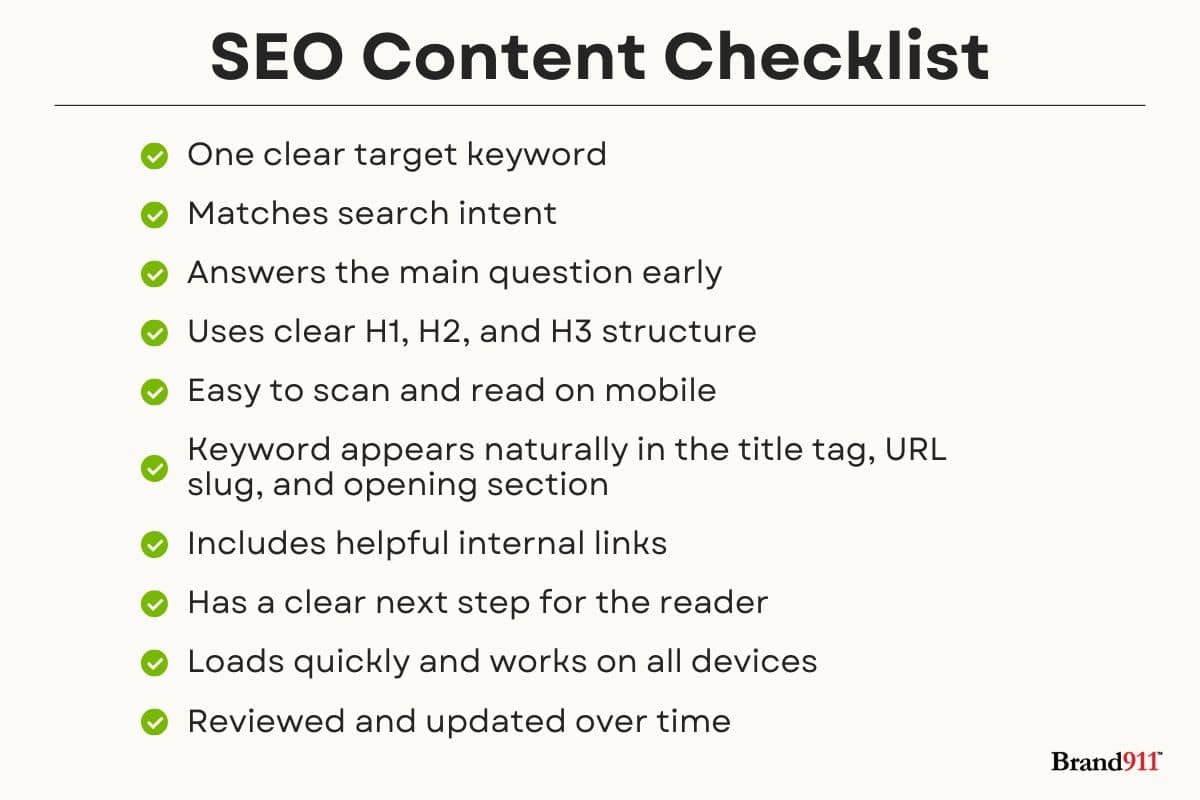
- One clear target keyword
- Matches search intent
- Answers the main question early
- Uses clear H1, H2, and H3 structure
- Easy to scan and read on mobile
- Keyword appears naturally in the title tag, URL slug, and opening section
- Includes helpful internal links
- Has a clear next step for the reader
- Loads quickly and works on all devices
- Reviewed and updated over time
If a page misses several of these, it’s unlikely to rank or convert.
How Long Does SEO Content Take to Work?
SEO content doesn’t work overnight. Search engines need time to crawl, test, and rank new pages.
Here’s a realistic way to think about timing.
- First few weeks: Your page may appear in search results and start collecting impressions. Rankings often move up and down during this phase.
- One to three months: Patterns start to form. You may see steady organic traffic if the content matches intent and competition is reasonable.
- Three months and beyond: Strong pages settle into more consistent rankings. This is when SEO content often begins driving meaningful traffic and leads.
Results depend on your site’s authority, competition, and content quality. Regular updates and small improvements can speed progress and extend results over time.
Next Step: Turn Your Content Into a System
SEO content works best when it’s part of a plan, not a guessing game. When each page has a role, supports a goal, and connects to the rest of your site, results compound.
Key takeaways to remember:
- SEO content is built around real searches and clear intent
- Structure and clarity matter as much as the words themselves
- One strong page can outperform dozens of unfocused posts
- Small updates often drive bigger gains than constant publishing
At Brand911, our seo services help businesses turn scattered content into a system that supports visibility, trust, and growth. That might mean clarifying your keyword strategy, fixing underperforming pages, or creating content that actually supports conversions.
If you’re publishing and nothing is moving, you don’t need more posts. You need a clearer plan.
Frequently Asked Questions (FAQs) About SEO Content
Can a beginner do SEO content?
Yes. Beginners can create SEO content if they focus on the basics: clear topics, real search intent, and readable structure. The challenge usually isn’t writing—it’s choosing the right keywords and understanding what Google expects to rank.
Can I do SEO myself, or should I hire help?
You can do SEO yourself, especially early on. Many businesses start with DIY SEO and hit a plateau. That’s often the point where strategy, site structure, and prioritization matter more than effort alone.
What are the 4 types of SEO?
The four main types of SEO are:
- On-page SEO: content, keywords, headings, internal links
- Off-page SEO: backlinks and external signals
- Technical SEO: site speed, indexing, crawlability
- Local SEO: location-based searches and map results
SEO content lives mostly in on-page SEO but supports all four.
What are the 3 C’s of SEO?
The three C’s are:
- Content: pages that answer real searches
- Code: clean structure and technical health
- Credibility: trust signals like backlinks and experience
Strong SEO content supports all three.
What is an example of SEO content?
A good example is a service page answering “How much does X cost?” or a comparison page like “X vs Y.” These target specific searches, match intent, and guide visitors toward a decision.
Which type of SEO is best?
No single type works on its own. SEO content performs best when it’s supported by solid technical foundations, clear on-page structure, and growing credibility. Content is the engine, but it needs support to go far.
About us and this blog
We are a digital marketing company with a focus on helping our customers achieve great results across several key areas.
Request a free quote
We offer professional SEO services that help websites increase their organic search score drastically in order to compete for the highest rankings even when it comes to highly competitive keywords.
Subscribe to our newsletter!
More from our blog
See all posts




Recent Posts
- What is an SEO Strategy? January 8, 2026
- What Is Digital PR? A Practical Guide to Building Trust Online January 6, 2026
- How to Do a Content Gap Analysis December 30, 2025


Recent Comments