


Most SEO advice focuses on tactics. But, without direction, those tactics won’t get you anywhere. If your website traffic and business outcomes feel random and hard to measure, you’re probably missing one thing. A clear SEO strategy.
Quick Summary:
An SEO strategy is a clear plan for improving search visibility by aligning content, structure, and authority with how people actually search. It turns SEO from scattered tactics into a system that drives consistent growth.
Here are the steps to create an SEO strategy:
- Audit your website and set clear goals
- Understand your audience and keywords
- Study your competition
- Plan content and topic clusters
- Map out your conversion funnel
- Fix technical and on-page issues
- Build backlinks and authority
- Measure results and adjust as needed
What is an SEO Strategy?
An SEO strategy is a comprehensive plan to improve your website’s visibility in search results so the right people can find you. You earn traffic organically instead of buying it through ads.
A strong SEO strategy helps your site rank higher in organic search, attract qualified visitors, and support real business goals like leads, conversions, and brand awareness.
(If you’re new to the basics, our SEO guide for beginners breaks down how search engines work and why organic visibility matters.)
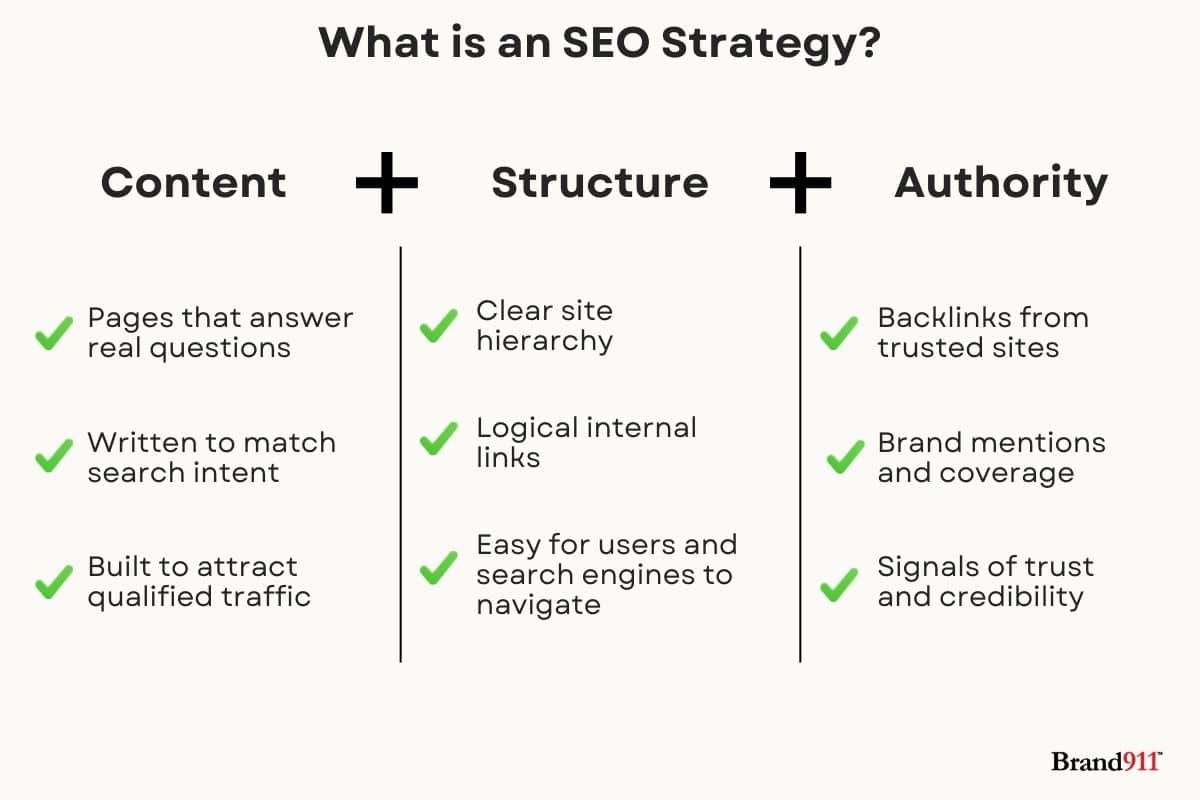
Your SEO strategy should be guided by three questions:
- What is my audience searching for? → This shapes your keywords, topics, and content priorities.
- How should my site be structured and written to match that intent? → Pages, navigation, and content need to align with how people search and think.
- How can I earn trust and authority in search results? → Rankings come from credibility signals like quality content, links, and brand mentions.
Once you can clearly answer those questions, your SEO efforts stop feeling scattered and instead become purposeful.
Benefits of an SEO Strategy
A real SEO strategy does a lot more than just “help you rank”. It keeps your marketing focused and turns those rankings into real business outcomes.
Attract qualified visitors
When your content matches what your audience is already searching for, you attract people with intent. That means:
- More of the right traffic
- Fewer wasted clicks
- Higher chance of leads and sales
Build trust and authority
Search rankings influence user perception. When you show up near the top, people are more likely to trust you before they even click to your site.
Cost-effective over time
SEO doesn’t charge you per click. That makes it a strong long-term channel compared to pay-per-click, where traffic stops when you stop spending.
And yes, strong organic growth ties directly to revenue. Semrush shared a case study where Morningside Acupuncture quadrupled their revenue after major SEO-driven growth.
Higher ROI with consistency
SEO builds on itself over time. Every page you publish becomes another asset that can keep bringing in traffic. Each improvement makes it easier for future content to rank. And every small win gives you data and proof you can build on instead of starting from scratch.
Blogging drives results
Blogging regularly continually creates new entry points for people to get to your website. Each post is another page that can rank highly, pull in search traffic, and introduce (or re-introduce) your brand to a potential customer.
Key Elements of an SEO Strategy
An SEO strategy really comes together when multiple parts support each other.
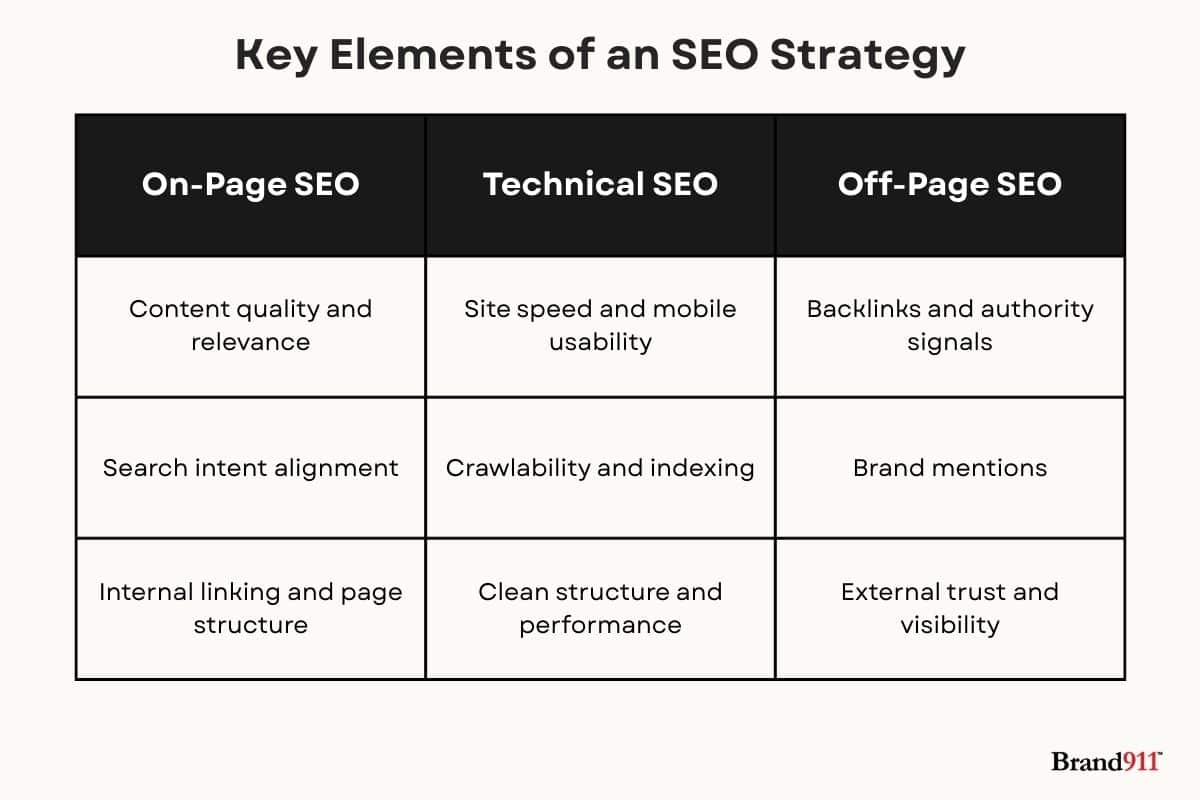
On-Page SEO
On-page SEO focuses on what lives on your website. Your content, website structure, and certain signals tell search engines what each page is about and who it is for.
Here are the core pieces:
- High quality content: Create original seo content that answers real questions and helps your audience make decisions. Useful, clear content is what search engines want to rank.
- Keyword research and user intent: Identify the exact queries your audience uses and focus on the reason behind each search. Clear intent leads to better traffic and stronger conversions.
- Topic clusters: Organize content around core topics using pillar pages and supporting subpages. This structure shows authority and makes your site easier to navigate.
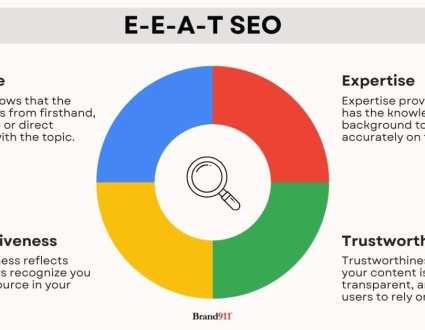
- E-E-A-T signals: Show Experience, Expertise, Authoritativeness, and Trustworthiness through depth, accuracy, and real-world insight. These signals support rankings and help content appear in AI results.
- Internal linking: Link related pages to guide users, distribute authority, and help search engines understand how your content connects.
- Meta tags and headings: Use clear meta titles around 60 characters, meta descriptions between 120–150 characters, one H1 per page, and logical H2–H6 headings to improve clarity and click-through rates.
Technical SEO
Technical SEO makes sure your site is easy for search engines to access, understand, and rank. Even strong content will struggle to perform if your technical SEO is weak.
Here’s what to focus on:
- Site speed: Your pages should load in under three seconds. Faster sites rank better, keep users engaged, and reduce drop-offs.
- Mobile-friendly design: Most searches happen on mobile. Google ranks your site based on its mobile version first, not desktop. If your mobile experience is poor, rankings suffer. Learn more about Google’s mobile-first indexing.
- Clear site structure: A logical structure with clean, descriptive URLs helps users navigate and helps search engines understand how pages relate to each other.
- Crawlable pages: Search engines need access to your CSS and JavaScript files to properly render and interpret your pages. Blocked resources limit visibility.
- Schema markup: Structured data tells search engines what your content represents, such as articles, events, FAQs, or products. This can improve how your pages appear in search results.
- SSL certificates: HTTPS protects user data and signals trust. Secure sites are favored by both users and search engines.
- XML sitemaps: A sitemap helps search engines discover and prioritize your most important pages, especially on larger or newer sites.
- User experience: Technical SEO supports usability. Fast load times, readable layouts, and stable pages keep users engaged, which reinforces positive search signals
Off-Page SEO
Off-page SEO focuses on how your site is referenced across the web. These signals tell search engines whether your brand is trusted outside your own website.
Here’s where to start:
- Earning quality backlinks: Building backlinks is one of the best ways to send out strong ranking signals. Links from relevant, authoritative sites carry more weight, so focus on quality, not quantity.
- Brand mentions: Coverage on reputable sites builds authority even when a link is not included. Mentions reinforce visibility, trust, and brand recognition in search results.
- Guest posting on relevant sites: Publishing articles on industry-relevant websites helps you reach new audiences while earning contextual links that support authority.
- Local SEO signals: For businesses with a geographic focus, local visibility matters. Optimizing your Google Business Profile and earning real customer reviews helps you appear in map results and local searches.
How to Create an SEO Strategy (8 Steps)
Step 1: Audit and Set Clear Goals
Before you create anything new, you need to understand where you’re starting from. This helps you measure progress and know if your strategy is working or not.
- Review current performance: Look at your existing organic traffic, keyword rankings, and top-performing pages. This shows what is already working and where gaps exist.
- Check technical health: Identify issues that could limit visibility, such as slow pages, indexing problems, or broken links. These issues often block growth even when content is strong.
- Set clear, business-driven goals: SEO goals should connect to outcomes that matter, like qualified leads, sales, or visibility for key services.
- Define what success looks like: Choose a small set of KPIs to track progress, such as organic traffic growth, ranking improvements, or conversions from search.
- Decide what not to do: Focus improves results. Be clear about which keywords, pages, or tactics you will ignore so your effort stays aligned.
Step 2: Know Your Audience and Keywords
SEO works best when you do it for the people who will be interacting with your content. Don’t write just to rank. Make the connection between what your audience needs and what they search.
When you understand who you’re speaking to and why they are searching, your content becomes easier to plan and easier for Google to rank.
- Build audience personas: Define who you are trying to reach. Focus on their problems, goals, and questions, not just age or job title.
- Map the buyer’s journey: Identify how someone moves from awareness to consideration to action. Each stage needs different content and different keywords.
- Research keywords and intent: Look for the exact phrases your audience uses when searching. Prioritize clarity over volume.
- Focus on long-tail searches: Longer, more specific queries often convert better because the intent is clearer and closer to action.
- Understand the “why” behind each search: Two keywords can look similar but signal very different needs. Matching intent is what turns rankings into results.
For a deeper breakdown of how intent shapes SEO decisions, see our guide on how to determine search intent.
Step 3: Study Your Competitors
Competitor research shows you what already works in search and where you can improve. You’re not copying, just learning from the landscape so you can build on proven demand.
- Identify your real search competitors: Look at who ranks for the keywords you want, not just who you compete with offline. These are often different businesses.
- Analyze their content: Review the pages driving their traffic. Pay attention to topics, format, depth, and how they structure information.
- Spot patterns and priorities: Notice which themes show up repeatedly and which pages earn the most visibility. This reveals what search engines reward in your space.
- Find content gaps: Identify questions your competitors do not fully answer or topics they ignore. These gaps are opportunities to create stronger, more useful content – and you can find these through a content gap analysis.
- Review backlink profiles: Look at where competitors earn links and mentions. This helps you understand what types of content attract authority in your industry.
Step 4: Plan Content and Topic Clusters
This is where all your research turns into a content plan. Remember, structure matters as much as the content itself.
Topic clusters turn scattered posts into an authority-build system. Here’s what to do:
- Map out core topics: List the main subjects your audience cares about based on keyword research and competitor insights. These topics should tie directly to your services or expertise.
- Create pillar and cluster pages: Use pillar pages to cover broad topics in depth. Support them with cluster pages that answer specific questions or explore subtopics. This structure helps search engines understand your authority and helps users find what they need.
- Connect content intentionally: Link cluster pages back to the pillar and to each other where it makes sense. This keeps users engaged and strengthens topical relevance.
- Build an editorial calendar: Plan what you will publish and when. Consistency matters more than volume. A realistic schedule keeps your strategy moving forward.
- Publish with purpose: Every piece of content should support a larger topic, not exist in isolation.
For practical tips on planning and publishing, see our guide to SEO-friendly blogging.
Step 5: Map Your Conversion Funnel
Many businesses simply aim for more and more and more traffic. That’s where their SEO strategy falls apart.
Your content should support the entire customer journey and full marketing funnel. This is what turns traffic into leads and real business.
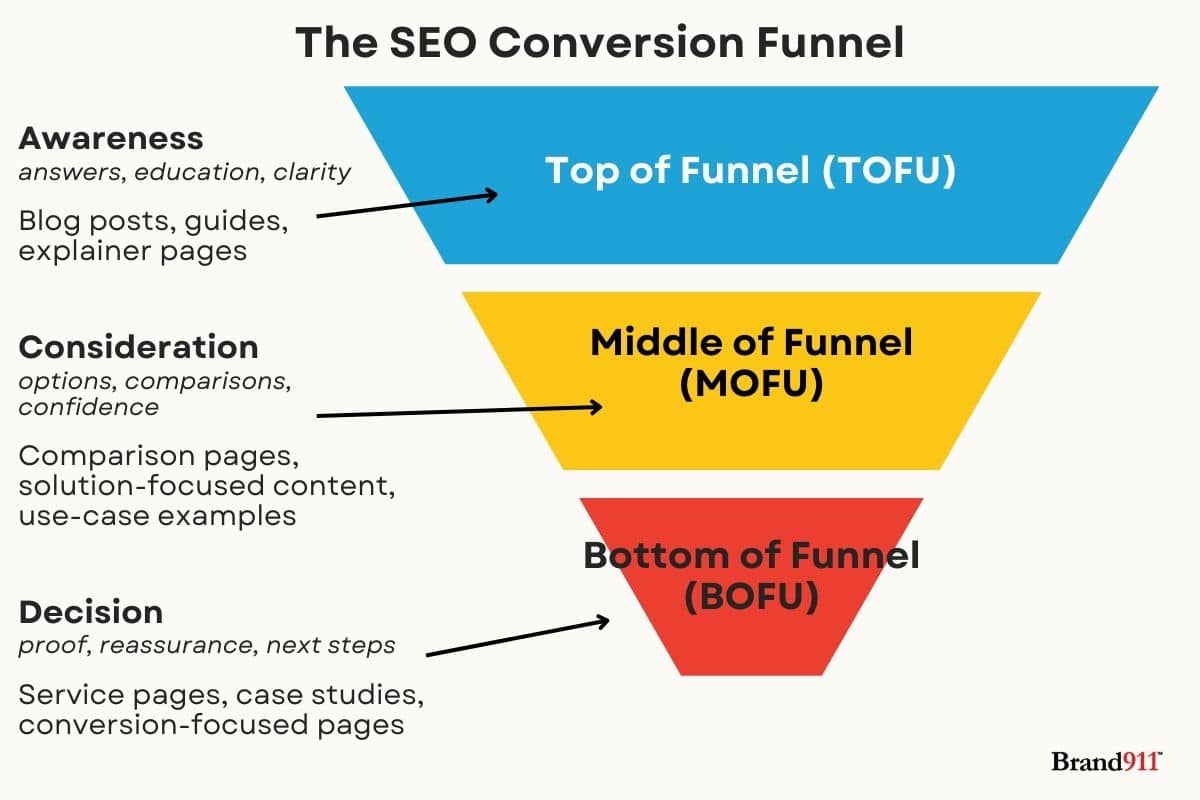
The SEO Conversion Funnel:
| Funnel Stage | What the Searcher is Doing | What You Content Should Do |
| Top of funnel (awareness) | Learning, researching, trying to understand a problem | Educate, explain, and clarify |
| Middle of funnel (consideration) | Comparing options and evaluating solutions | Help them decide what fits |
| Bottom of funnel (decision) | Ready to act or contact a provider | Remove friction and guide action |
Once the funnel is clear, your SEO decisions get easier.
- Map pain points to keywords: Each stage comes with different questions and concerns. Match those concerns to the searches people use at that moment.
- Align content to intent: Informational content supports awareness. Comparison and solution content supports consideration. Service and conversion pages support decisions.
Step 6: Fix Technical and On-Page Issues
Once your plan is in place, remove anything that could block your site’s performance. This won’t necessarily create traffic on its own, but it does remove barriers that prevent your SEO from working.
- Prioritize technical fixes: Address issues that prevent search engines from crawling or users from staying on your site. Start with crawl errors, slow load times, and Core Web Vitals, since these directly affect visibility and engagement.
- Optimize title tags and meta descriptions: Write titles around 60 characters that reflect search intent and include your main keyword. Craft meta descriptions between 120–150 characters to set clear expectations and improve click-through rates.
- Use header tags correctly: Each page should have one H1 that defines the main topic. Use H2 and H3 headings to break up content and guide readers through the page.
- Build internal links intentionally: Connect related pages so users can move naturally through your site. Internal links also help search engines understand which pages matter most.
Step 7: Build Links and Authority
Authority is built outside your website in the form of backlinks, brand mentions, and general coverage. These send signals to search engines, letting them know that others trust your brand.
Here’s where to start building backlinks:
- Plan link-building tactics: Identify the types of sites you want links from and the methods you’ll use (ex. digital pr, guest content, or resource links). Prioritize relevance and credibility over volume.
- Create link-worthy content: Publish assets people want to reference. Original research, clear guides, and useful resources attract links naturally over time.
- Use strategic outreach: Reach out to relevant sites, publishers, and journalists. Give them a reason to care. Outreach works best when it adds value, not when it feels transactional.
Common link-building approaches include:
- Digital PR: Earn mentions and links from news outlets and industry publications by sharing data, insights, or expert commentary.
- Broken link building: Find broken links on relevant websites and suggest your content as a replacement when it genuinely fits.
- Guest posting: Contribute articles to reputable sites in your niche to reach new audiences and earn contextual backlinks.
- Link-worthy assets: Create visuals, tools, or resources that are easy to reference and share.
- Becoming a source: Position your team as experts journalists can quote for stories and commentary.
Step 8: Track Results and Improve
Measuring impact is essential if you want your SEO strategy to succeed. You can’t just “set it and forget it.” Here’s what to track so you can monitor results and improve as you go:
- Monitor key KPIs: Track organic traffic, keyword rankings, impressions, and click-through rates. These numbers show whether your visibility is actually improving.
- Track conversions from search: Pay attention to actions that matter, like form submissions, downloads, bookings, or calls that come from organic traffic.
- Look for patterns, not just spikes: Short-term movement is normal. Focus on trends that show steady growth or repeated wins.
- Report consistently: Regular reporting keeps your strategy grounded. It shows what’s working, what’s stalling, and where to adjust.
- Refine based on results: Use performance data to guide your next moves instead of guessing. Update content, adjust priorities, and double down on what produces results.
For a deeper look at tying performance to outcomes, see our guide on how to measure content marketing ROI.
How is AI Changing SEO Strategy?
AI is reshaping how search engines work and how websites earn their visibility.
SEO still matters. It’s not dead, as some claim. In fact, quality SEO and content are more important than ever as algorithms get better at understanding what searchers want.
Here’s what’s changing:
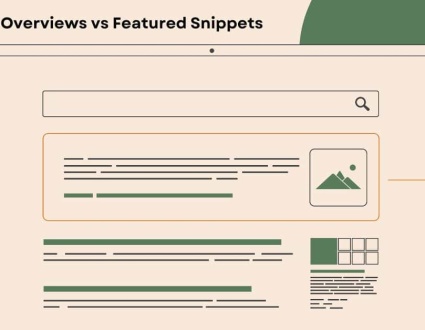
- AI Overviews and large language models: Search engines now summarize answers directly on the results page. This changes how users interact with search and reduces the need to click through in some cases.
- More zero-click searches: Many searches now end without a website visit. That makes visibility, clarity, and authority more important than raw traffic alone.
- New optimization frameworks: You’ll see new terms used to describe how SEO adapts to AI-driven search:
- GEO (Generative Engine Optimization) focuses on making content usable in AI-generated responses. Strong SEO fundamentals support this.
- AEO (Answer Engine Optimization) centers on clear, direct answers that AI and voice tools can surface.
- AIO (Artificial Intelligence Optimization) is a broader way to describe optimizing content across AI-powered platforms.
- Conversational search is increasing: Searches now sound more like real questions. Optimizing for natural language and specific intent helps content appear in both search results and AI summaries.
Despite more zero-click searches, ranking in AI overviews should still be a key part of your SEO strategy. Cited websites get more visibility here, and AI search means many websites now receive more qualified traffic – meaning the people who do come to your website are more likely to convert.

Using AI to Improve Your SEO Strategy:
AI is both changing how search engine algorithms work and how SEO work gets done.
Here’s how you can use AI to boost your SEO:
- AI-powered keyword research: AI tools can surface conversational queries and topic relationships that are easy to miss with traditional methods.
- Content assistance: AI works best as a support tool. Use it for outlines, structure, and research so your team can focus on unique insight and accuracy.
- Content optimization support: AI can review pages and suggest improvements for clarity, relevance, and structure.
- Faster technical audits: AI-powered tools can scan sites quickly to flag broken links, slow pages, and crawl issues.
- Trend prediction: AI can analyze patterns in search behavior to help you prepare for shifts instead of reacting late.
Conclusion: Turn SEO Into a Growth System
The right SEO strategy gives structure to everything you do for your website.
Instead of chasing rankings, you build a system that attracts the right traffic and compounds over time. A clear, cohesive strategy means that SEO becomes predictable instead of reactive.
Key Takeaways:
- An SEO strategy connects visibility to real business goals
- Search intent matters more than keywords alone
- Strong structure makes content easier to rank and easier to scale
- Authority is earned through links, mentions, and trust signals
- Consistent effort compounds instead of resetting each month
If you want SEO to drive growth instead of creating more guesswork, we can help. Explore how our SEO services can support your brand’s visibility, credibility, and long-term success.
Frequently Asked Questions (FAQs) About SEO Strategy
What tools do you need to create an SEO strategy?
SEO tools help you measure performance, understand search demand, and identify issues on your site. Here’s what’s essential:
- Google Analytics 4 for traffic and conversions
- Google Search Console for rankings, indexing, and visibility
- Keyword research tools to assess demand and intent
- Page speed and technical tools to flag performance issues
- Content and AI tools to support planning and optimization
How long does it take to see results from an SEO strategy?
SEO is a long-term channel.
- Small improvements can appear within weeks
- Meaningful growth typically takes 6 to 12 months
- Results depend on competition, site history, and consistency
What is the difference between an SEO strategy and SEO tactics?
An SEO strategy defines your overall direction and guides priorities. SEO tactics are the actions you take to execute the plan.
Is an SEO strategy still worth it with AI and zero-click searches?
Yes. SEO now focuses on visibility, authority, and trust, not just clicks. Strong SEO increases brand presence across search, AI summaries, and discovery surfaces.
How often should I update my SEO strategy?
SEO strategies should be reviewed regularly.
- Minor adjustments monthly
- Larger reviews quarterly
- Major updates when search behavior or business goals change. You should review your strategy when Google makes a core algorithm update.
Can small businesses compete with larger sites using SEO?
Yes. Smaller sites can win by focusing on clear intent, niche topics, and consistent publishing instead of broad, competitive keywords.
What makes an SEO strategy successful?
A successful SEO strategy is clear, focused, and measurable. It aligns content with search intent, removes technical barriers, and builds authority over time through consistent effort.
About us and this blog
We are a digital marketing company with a focus on helping our customers achieve great results across several key areas.
Request a free quote
We offer professional SEO services that help websites increase their organic search score drastically in order to compete for the highest rankings even when it comes to highly competitive keywords.
Subscribe to our newsletter!
More from our blog
See all posts





Recent Posts
- What is an SEO Strategy? January 8, 2026
- What Is Digital PR? A Practical Guide to Building Trust Online January 6, 2026
- How to Do a Content Gap Analysis December 30, 2025


Recent Comments