


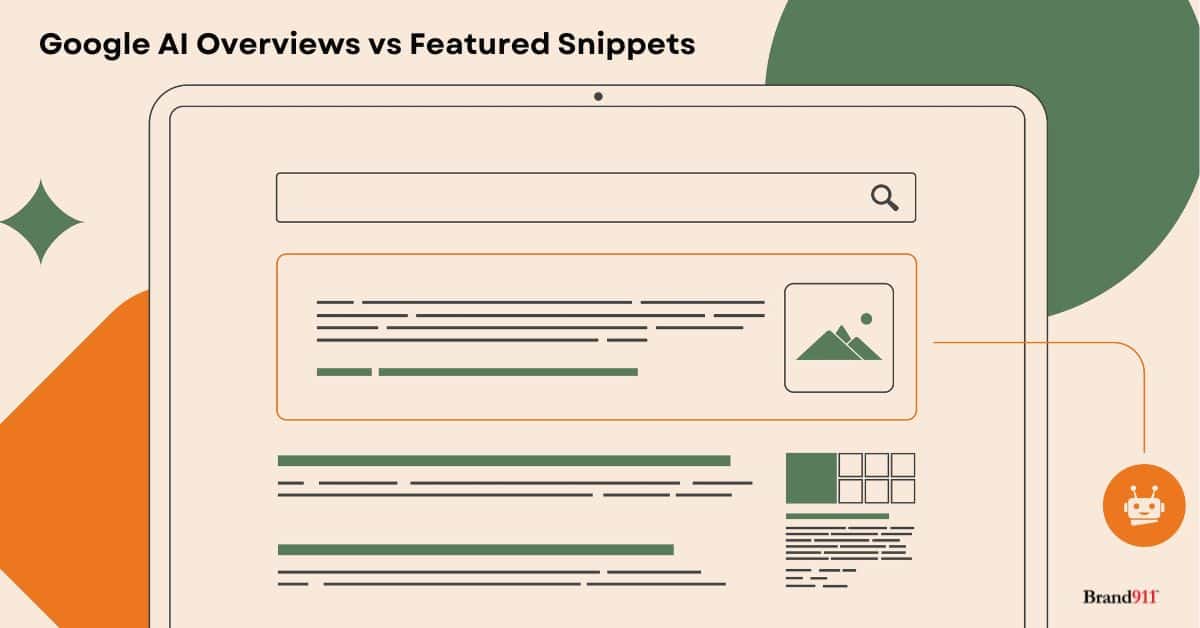
You want your content to show up in high-visibility SERP features, but it’s hard to know whether you should focus on AI Overviews, Featured Snippets, or both.
Each one works differently, appears in different search situations, and impacts your traffic in its own way.
This guide breaks down the key differences, why ranking in these features matters, and the content adjustments that help you appear in either or both. If you want to understand where to focus your SEO efforts, you’re in the right place.
Summary:
AI Overviews and Featured Snippets both appear at the top of Google’s results, but they work differently and influence SEO in different ways. Snippets give direct answers from one page, while AI Overviews generate multi-source summaries. To stay visible, your content needs to support quick answers and deeper explanations.
Table of Contents
- What Are Featured Snippets?
- What Are AI Overviews?
- Key Differences
- How They Affect SEO
- Content Tweaks to Rank in Both
- Should You Still Target Featured Snippets?
- Conclusion
- FAQs
What are Featured Snippets?
Featured Snippets are one of Google’s original SERP features and have been part of search results for years. Traditionally, they used to appear at the very top of the page—often called “position zero”—giving users a quick answer to their question without requiring a full click-through. Nowadays, however, AI Overviews are appearing at the top of the page, above Featured Snippets and regular organic results.
Since AI Overviews have appeared, Featured Snippets show much less frequently, but it’s still valuable to rank in them when they do appear.
Google pulls the snippet directly from a single webpage, not from multiple sources or AI-generated summaries. The content you see in a Featured Snippet is an exact excerpt, lifted word-for-word from the page Google believes provides the clearest answer.
Featured Snippets come in several formats, including:
- Short paragraph summaries
- Numbered or bulleted lists
- Tables
- Video excerpts, often from YouTube
Because snippets extract exact text from your content, your page needs clear, well-structured answers that Google can easily recognize and display.
What are AI Overviews?
AI Overviews are Google’s newer, AI-generated summaries created using the Gemini model.
They appear at the top of the search results for certain queries and often take up a significant amount of space on the page.
Instead of quoting one webpage directly, Google’s AI pulls information from multiple sources—usually from pages already ranking in the top organic results—and writes a new, synthesized summary.

The content inside an AI Overview isn’t copied from any single site. It’s a fresh explanation generated by Google’s AI based on patterns, context, and signals across the web. Because these summaries appear so prominently, they play a major role in how users find and interact with information online.
If you want to improve how your content shows up in today’s search results, explore our guide on strengthening your overall search visibility.
Featured Snippets vs AI Overviews: Key Differences
Here’s a clear, side-by-side comparison of how each SERP feature works and what sets them apart.
| Category | Featured Snippets | AI Overviews |
| Source | Extracted from a single webpage | Generated by Google’s Gemini model using multiple sources |
| Content Type | Direct quote pulled word-for-word | New summary written by AI based on gathered information |
| Placement | Appears in “position zero” above organic results | Appears at the very top of the SERP, often above snippets |
| CTR Impact | Can increase clicks when you own the snippet | May reduce clicks by keeping users on the SERP longer |
| Appearance | Less common today but still present | Appears more frequently across many informational queries |
| Trigger | Clear, concise questions with direct answers | Broader, multi-part, or complex informational queries |
| Sourcing Depth | One primary source | Multiple sources, typically from top-ranking pages |
| Interactivity | Static answer box | Interactive summaries with citations and follow-up prompts |
How AI Overviews and Featured Snippets Affect SEO
AI Overviews and Featured Snippets both change how users interact with search results, but they affect your SEO strategy in different ways.
Understanding these shifts helps you decide how to structure your content and where to focus your efforts. If you need a refresher on SEO fundamentals, start with our beginner’s guide to SEO.
Fewer Clicks and More Zero-Click Searches
As Google answers more questions directly on the SERP, fewer users click through to individual websites. Featured Snippets already reduced the need to click for simple questions, but AI Overviews expand this behavior even more.
Their longer summaries and multiple citations give users enough information to stay on the page, increasing the number of zero-click searches. This means your content needs to deliver value in multiple ways—through visibility, brand recognition, and authority—not just clicks alone.
Changes to the Search Results Page
Both features reshape the layout of the results page. Featured Snippets sit above the organic listings, but AI Overviews take up even more space and can push everything else further down.
This affects how often users scroll, how they navigate the page, and which links they choose to explore. You may still benefit from ranking well, but your visibility depends more on SERP features than traditional positions alone.
Where AI Overviews Get Their Data
AI Overviews pull information from many sources across the web, often relying on pages that already appear in the top organic results. Google’s Gemini model analyzes these pages, identifies key details, and generates a new summary based on consistent patterns across those sources.
Because of this, strong technical SEO, topical authority, and clear on-page structure all increase your chances of being cited. The more trustworthy and comprehensive your content is, the more likely it is to be included in an AI-generated overview.
Content Tweaks to Rank in Featured Snippets and AI Overviews
Small adjustments to your content structure can make a big difference in whether Google chooses your page for Featured Snippets, AI Overviews, or both.
➡️Here’s a deeper breakdown on ranking in AI Overviews specifically.
Write Authoritative, Snippet-Ready Content
Google favors content that answers questions clearly, confidently, and with enough depth to trust.
Here’s how to shape your writing so it works for both SERP features:
- Structure content around questions. Use headings like “What is…”, “How does…”, or “Why does…” so Google can match your content directly to user queries.
- Use formatting that’s easy to extract. Write short paragraphs, use lists, and organize information in clean sections.
- Keep content fresh. Update examples, refresh explanations, and review older pages regularly.
- Demonstrate expertise. Include clear explanations, cite credible sources, and make your experience visible.
These tweaks help Featured Snippets pull your exact wording and give AI Overviews enough confidence to surface your content as a reliable source.
Structure Your Site for AI Overviews and Snippets
Your site’s structure plays a major role in whether Google trusts your content enough to feature it. Strong technical foundations make it easier for Google to read, interpret, and surface your pages in both Featured Snippets and AI Overviews.
Here’s what to prioritize:
- Use structured data. Add schema markup for FAQs, How-To guides, and Q&A sections to help Google understand your content’s purpose and layout.
- Prioritize speed and mobile-friendliness. Fast, responsive pages reduce drop-offs and make your content more competitive for SERP features.
- Use internal linking. Connect related content so Google can follow your topic clusters and understand your authority across the subject.
- Maintain clean technical SEO. Fix broken links, improve crawlability, and keep your site structure organized so Google can index the right pages.
These steps help your content qualify for both direct-answer features and AI-generated summaries.
Update Your Keyword and Content Strategy
Ranking in today’s SERP features requires a more intentional approach to keyword targeting and content development. AI Overviews and Featured Snippets reward pages that are well-organized, easy to interpret, and clearly aligned with search intent.
Here are the shifts to make:
- Target long-tail keywords. These searches are more specific and often trigger both Featured Snippets and AI-generated summaries.
- Build topic clusters. Create a hub-and-spoke structure that covers a subject in depth, then link your pages together to show authority.
- Diversify content formats. Mix paragraphs, lists, tables, FAQs, and visuals to give Google multiple ways to understand your content.
- Focus on user intent. Match your content to what the searcher actually wants—quick answers, in-depth explanations, or step-by-step guidance.
- Write in passages. Make each paragraph a single, complete thought so Google’s AI can extract clean snippets and use your content in summaries.
These adjustments help your content serve both Google’s answer-first features and the humans reading them.
Should You Still Target Featured Snippets?
Yes—Featured Snippets still matter. Even with AI Overviews taking up more space in the SERP, snippets continue to deliver strong benefits.
They often earn higher click-through rates than standard organic results, and they’re the content voice assistants rely on for spoken answers.
AI Overviews and Featured Snippets also appear together on many informational queries, giving your page two opportunities to reach users instead of one.
If voice search is part of your strategy, make sure to review our guide on voice search optimization.
When to focus on Featured Snippets:
- Direct, informational queries. These are “what is,” “how to,” or definition-style searches where a concise answer is expected.
- Niche topics. Smaller or highly specialized niches often see fewer AI Overviews, making Featured Snippets a stronger opportunity.
- Healthcare and other YMYL fields. Many health-related queries still surface both AI Overviews and Featured Snippets, giving authoritative sites more visibility.
- Building authority. Winning snippets signals expertise, reinforces credibility, and helps Google understand that you provide reliable information.
If your content can answer a question clearly and quickly, Featured Snippets remain an effective SEO target.
When to focus on AI Overviews:
AI Overviews reward broader explanations, deeper expertise, and content that covers multiple angles of a topic. They’re ideal for queries where users want context—not just a quick definition.
You should focus on ranking in AI Overviews when:
- Complex or multi-step informational queries. Searches that require deeper explanations, comparisons, or multiple factors often trigger AI-generated summaries.
- Topics with high search volume. Broad subjects tend to surface AI Overviews more often, especially when many sources cover the same question.
- Saturated niches. When many competitors target the same keywords, AI Overviews can highlight your content even if it isn’t ranking first.
- Subject areas where Google prefers synthesized information. This includes education, research-heavy topics, technical fields, and content that benefits from multiple perspectives.
- Building topical authority. If your site covers a topic in depth through clusters and internal links, AI Overviews give you more opportunities to be cited.
If your content provides comprehensive, well-structured explanations, ranking in AI Overviews becomes a powerful way to stay visible—even when traditional click-through patterns change.
Conclusion: Adapting Your SEO Strategy for Today’s SERPs
Google’s shift toward AI-generated results doesn’t mean traditional SEO is fading—it means your content needs to work harder in more than one way. Featured Snippets and AI Overviews each serve different user needs, and both can help your brand stay visible at the top of the page.
When you combine clear, concise answers with deeper, well-structured explanations, you position your content to perform across both SERP features. The goal is simple: give Google the best possible version of your content, no matter how the search results evolve.
Key Takeaways
- Featured Snippets still drive value by delivering fast, direct answers and boosting authority.
- AI Overviews broaden the search experience and reward depth, context, and strong topic coverage.
- Your content should support both quick answers and long-form explanations to stay competitive.
- Use strong internal linking, structured formatting, and updated content to help Google surface your pages.
- For every keyword, determine what the user wants first—a simple answer or a more comprehensive explanation—and optimize accordingly.
Frequently Asked Questions (FAQs)
Do Featured Snippets still matter in 2025?
Yes—Featured Snippets still matter because they deliver fast, direct answers and can drive strong click-through rates. They remain valuable for clear informational queries and continue to support authority and visibility, even with AI Overviews becoming more common.
Will AI Overviews replace Featured Snippets?
No—AI Overviews are not replacing Featured Snippets. Each feature serves a different purpose: snippets extract a single-source answer, while AI Overviews generate multi-source summaries. Both can appear together on the same SERP, and Google continues to surface each based on user intent.
Can a page appear in both an AI Overview and a Featured Snippet?
Yes—your page can appear in both an AI Overview and a Featured Snippet for the same query. This often happens for informational searches where Google wants to offer both a quick answer and a deeper AI-generated summary.
How can I track my performance in AI Overviews?
You can track AI Overview visibility by monitoring the SERP manually, using AI Overview tracking tools, or reviewing changes in impressions and clicks for affected keywords. Look for shifts in CTR, appearance patterns, and how often your content is cited in AI-generated summaries.
What types of queries trigger AI Overviews?
AI Overviews typically appear for broad, multi-step, or informational queries where users benefit from a synthesized explanation. They often show up for topics that require context rather than quick answers.
What types of queries trigger Featured Snippets?
Featured Snippets usually appear for direct, answer-based queries such as “what is…,” “how to…,” or other definition-style searches. These queries favor short, structured answers that Google can extract from a single page.
How do I optimize a page for both AI Overviews and Featured Snippets?
Start with a clear, direct answer near the top of the page, then expand into deeper sections that provide context, examples, and related subtopics. Use headings, lists, clean formatting, and internal links to help Google understand your content from multiple angles.
Does ranking lower in the SERP hurt my chances of appearing in an AI Overview?
Not necessarily. AI Overviews pull information from multiple sources, and pages outside the top spot can still be cited. What matters most is the clarity, depth, and authority of your content—not just your position.
Do AI Overviews reduce website traffic?
They can. Because users get more information directly on the results page, some queries may see fewer clicks. This makes visibility, authority, and brand presence more important than relying on traditional CTR alone.
Should I change my SEO strategy because of AI Overviews?
Yes—adjust your content to support both short-form answers and long-form, authoritative explanations. Focus on topic clusters, structured headings, and internal linking so Google can understand the breadth of your expertise.
About us and this blog
We are a digital marketing company with a focus on helping our customers achieve great results across several key areas.
Request a free quote
We offer professional SEO services that help websites increase their organic search score drastically in order to compete for the highest rankings even when it comes to highly competitive keywords.
Subscribe to our newsletter!
More from our blog
See all posts




Recent Posts
- What is an SEO Strategy? January 8, 2026
- What Is Digital PR? A Practical Guide to Building Trust Online January 6, 2026
- How to Do a Content Gap Analysis December 30, 2025


Recent Comments