


Google no longer cares about content that simply “targets keywords”. You need to prove that you’re real, credible, and worth trusting. That’s where E-E-A-T SEO comes in.
You can publish as much content as you want, follow all the typical “SEO best practices”, and spend as much time on your website as you want. But, if you’re not following E-E-A-T guidelines, your pages won’t rank.
Baking E-E-A-T into your brand means your content will:
- Look more trustworthy to Google
- Feel more trustworthy to your ideal clients
- Hold up better when algorithms change (which they do often)
This guide will show you exactly how to do that, step-by-step.
Quick Summary
E-E-A-T stands for Experience, Expertise, Authoritativeness, and Trustworthiness. It’s the framework Google uses to judge whether your content is credible and worth ranking. When your brand demonstrates strong E-E-A-T signals, your site becomes more trustworthy, more visible, and far more resilient to algorithm updates.
Contents:
- What is E-E-A-T
- Why E-E-A-T Matters for SEO
- How E-E-A-T Shaped Brand Perception
- The 4 Components of E-E-A-T
- E-E-A-T in the AI Era
- How to Improve E-E-A-T
- E-E-A-T for Business vs Personal Brands
- Common E-E-A-T Mistakes
- Conclusion
- FAQs
What is E-E-A-T?
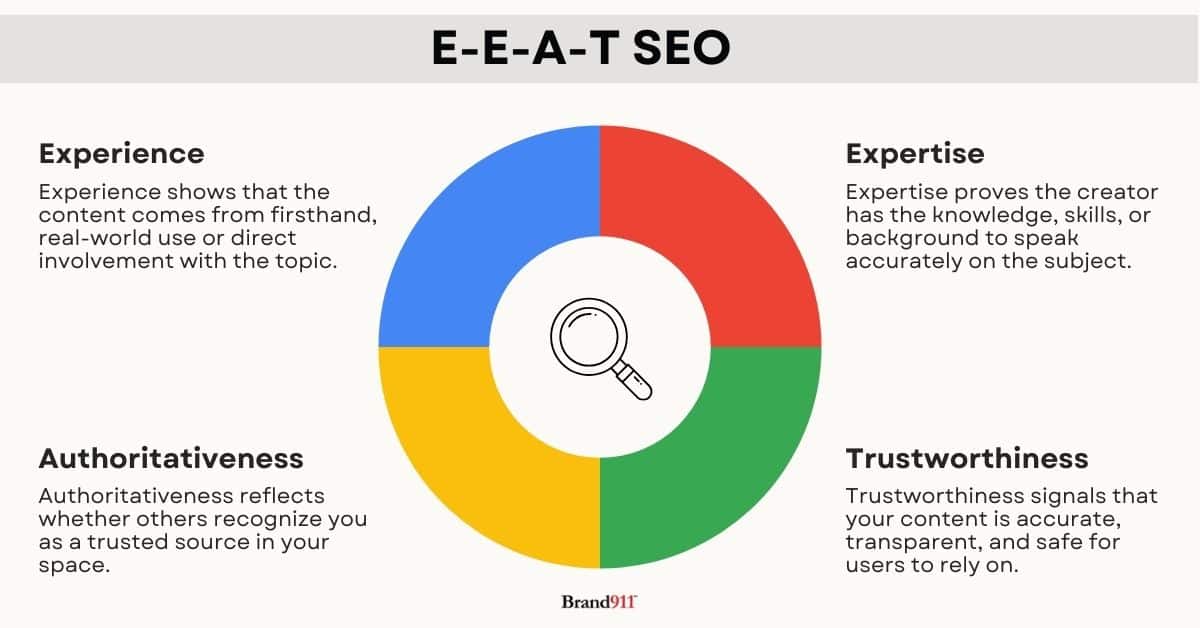
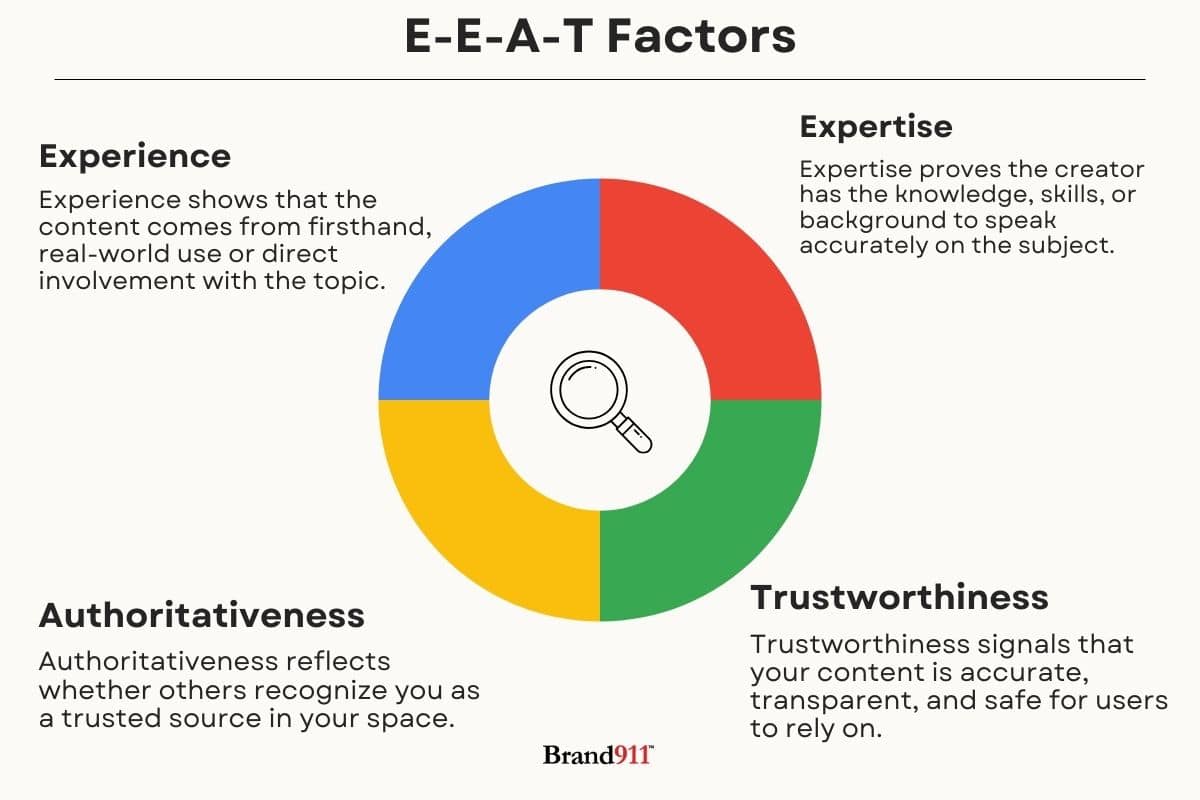
E-E-A-T is the guiding framework Google uses to determine which content to trust. When Google’s algorithm determines that your content is trustworthy, it rewards you by giving it a high ranking on the SERPS. The framework includes four concepts:
- Experience: Have you actually done what you’re talking about?
- Expertise: Do you have the knowledge or skills to teach it?
- Authoritativeness: Do others see you as a go-to source in your space?
- Trustworthiness: Is your content accurate, transparent, and safe for users?
E-E-A-T isn’t a direct “ranking factor,” but it affects every signal that does help you rank. When Google sees strong E-E-A-T, it sees a website worth showing to users.
Why E-E-A-T Matters for SEO
E-E-A-T shapes how Google decides which pages deserve visibility. When your content shows clear credibility, it becomes easier to rank and more resilient over time.
Strong E-E-A-T helps you:
- Improve your position in search results
- Build trust with readers faster
- Increase conversions through stronger credibility
- Avoid major drops during Core Updates and the Helpful Content Update
Google also relies on E-E-A-T to filter out misinformation and low-quality content. It wants reliable sources, not vague or generic answers.
E-E-A-T carries even more weight for YMYL (Your Money Your Life) topics—anything involving health, money, or safety—because the risk to users is higher and Google holds those pages to stricter standards.
Strong E-E-A-T makes it easier to improve your search visibility and stay competitive in crowded result pages.
How E-E-A-T Shapes Brand Perception
Beyond SEO, E-E-A-T also directly affects how people see your brand. When your content feels credible, users trust you faster, stay on your site longer, and take action more confidently.
Here’s why it matters for branding:
- Strong brands rank easier because users already trust them
- Clear trust signals make your content more convincing and lead to higher conversions
- A consistent brand identity across your site supports authority and expertise
- A real, branded author presence always beats anonymous or “Admin” content
When your brand looks trustworthy, Google notices (and so do the people you’re trying to reach).
Strong brands rank easier because users already trust them—and investing in ways to improve your brand reputation reinforces that trust across your entire online presence.
The 4 Components of E-E-A-T
Experience
Experience is about showing you’ve actually done what you’re talking about. Google wants proof that your insights come from real use, not assumptions or guesswork.
You can show experience through:
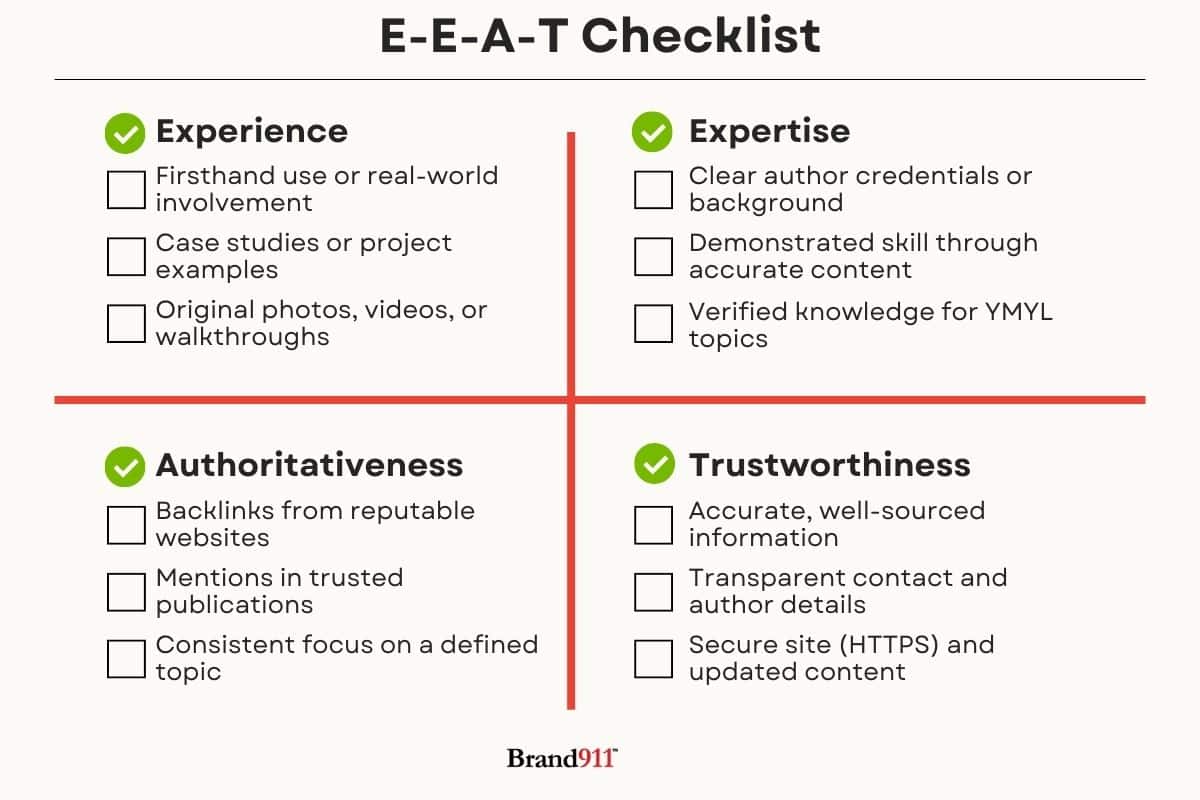
- Firsthand use of a product or service
- Case studies or project breakdowns
- Original photos, walkthroughs, and examples
Expertise
Expertise shows that the person creating the content knows what they’re talking about. Google looks for clear signals that the author has real knowledge, skill, or training in the subject.
You can demonstrate expertise with:
- Credentials or certifications
- Years of relevant experience
- Demonstrated skill through clear, accurate content
For YMYL topics—anything related to health, money, or safety—expertise carries even more weight. Google expects subject-matter credentials, verified knowledge, and reliable sourcing before it will trust that content.
For non-YMYL content, you can still show expertise by:
- Publishing high-quality content consistently
- Demonstrating hands-on skills in your explanations
- Showing depth of knowledge through detailed examples
- Solving problems your audience actually faces
Authoritativeness
Authoritativeness reflects how the outside world views your content and your brand. It’s about being recognized as a reliable source, not just claiming to be one.
You can build authority through:
- Backlinks from reputable websites
- Mentions or features in trusted publications
- A clear topical focus across your website
- Recognized thought leadership, such as interviews, quotes, or an active social presence
Trustworthiness
Trustworthiness is the foundation of E-E-A-T. If users can’t trust your content, nothing else matters. Google looks for clear signs that your site is safe, accurate, and transparent.
You can strengthen trust by:
- Publishing accurate, well-sourced content
- Making your contact information easy to find
- Securing your site with HTTPS
- Keeping your content updated and current
- Following clear editorial standards
- Presenting consistent, recognizable branding
E-E-A-T in the AI Era
AI has changed how content is created, but it hasn’t changed what Google wants. Google still prioritizes credibility, accuracy, and real-world insight—things AI cannot produce on its own.
AI cannot have real experiences, hold credentials, or take responsibility for what it publishes. Because of this, Google aggressively filters out generic AI content (or any generic content). Pages without clear E-E-A-T signals often lose visibility, especially in AI Overviews, where Google prefers brands and creators who show real authority.
Human oversight is now non-negotiable. The future of SEO belongs to brands that can prove they’re real.
Tips to Stand Out From Generic AI Content:
Most AI-generated content sounds the same. It lacks lived experience, point of view, and real-world depth. E-E-A-T is how you separate yourself from the noise.
You can do this by:
- Using human-led content strategies instead of automated bulk output
- Including personal examples, case studies, and original insights
- Showing transparent authorship with real names and real expertise
- Tying your content back to your brand story, mission, and values
How to Improve E-E-A-T
Improving E-E-A-T comes down to showing Google—and your audience—that your content is real, credible, and connected to an authentic brand. Here’s how to strengthen those signals across your site.
Strengthening E-E-A-T goes hand-in-hand with smart content marketing for SEO, where every page reinforces your expertise and trustworthiness.
On-Page Signals
Add real author bios
People want to know who created your content. Real names, photos, and short bios immediately make your pages more trustworthy.
Add credentials, awards, and media features
Show any relevant qualifications or recognition. These signals help Google understand why your content should be trusted.
Include original photos or examples
Original visuals, walkthroughs, and screenshots prove firsthand experience and separate you from generic AI content.
Cite reputable sources
Referencing credible research, government data, or industry publications reinforces accuracy and trust.
Update old content
Refreshing outdated content shows ongoing expertise and helps maintain trust—especially for topics that change rapidly.
Optimizing old blog posts is an easy win, helping you maintain credibility and stay current.
Add a clear About page and Contact page
Transparent information about who you are, what you do, and how to reach you builds confidence and supports trustworthiness.
Clarify who your business is and what you do
A clear brand story and service explanation help users (and Google) understand your purpose and authority.
Content Signals
Write how-to content from real experience
Practical, experience-driven content outperforms vague summaries. Show that you’ve done the work.
Real experience paired with SEO-friendly blogging gives your content the clarity and structure Google expects.
Add case studies or client stories
These offer proof, not claims. They also reinforce hands-on experience and authority.
Use specific examples
Specifics make your content more helpful and more believable—key signals for Google.
Avoid generic explanations
Generic content blends into the background. Your perspective, process, and insights are what make your content valuable.
Brand Signals
Strengthen your brand identity (visual + verbal)
Consistent branding shows stability and professionalism, both of which support trust.
Show consistency across your website
Your tone, design, and messaging should feel unified. Inconsistency creates doubt.
Be active on social platforms tied to your niche
A visible, engaged presence builds authority and shows users that you’re an active expert in your field.
Off-Page Signals
Earn quality backlinks
Earning backlinks from reputable sites are still one of the strongest signals of authority.
Get press mentions
Media mentions validate your expertise and elevate your brand’s credibility.
Earning mentions, interviews, and guest blogging helps build your authority beyond your own website.
Be featured as a source
Quotes, interviews, and expert contributions help establish you as a recognized authority.
Get more customer reviews
Reviews offer social proof and reinforce trustworthiness—especially for new visitors.
Social proof matters, and leveraging customer reviews helps reinforce your trustworthiness in both search results and user decision-making.
These signals work together to create a strong E-E-A-T foundation that supports better rankings, stronger brand perception, and higher conversions.
E-E-A-T for Business Brands vs Personal Brands
E-E-A-T applies to every type of brand, but how you demonstrate it depends on whether you’re building a business brand or a personal brand. Understanding the difference helps you focus on the signals that matter most.
Explain the difference (this helps readers understand which services they need).
Business Brands
Business brands need to show credibility at the organizational level. This means giving users a clear picture of who you are, what you do, and why you’re trustworthy.
Strong E-E-A-T for business brands includes:
- A clear brand identity that’s consistent across your website
- A trustworthy About page that explains your mission, values, and team
- Consistency across every page and platform linked to your brand
- Case studies, reviews, press features, and transparent leadership information
When users can quickly understand your business and see real proof of your results, trust builds fast.
Personal Brands
Personal brands rely on the individual, not the company, as the primary source of trust. Your background, experience, and reputation carry the weight.
Strong E-E-A-T for personal brands includes:
- A strong author profile that clearly shows who you are
- A narrative of experience that gives context to your expertise
- Consistent content on a focused topic or niche
- Credibility built through interviews, podcasts, guest articles, or speaking engagements
If you want to build your personal brand, you need a strong author profile, a clear voice, and visible signals of expertise that Google can verify.
Common Mistakes That Hurt E-E-A-T
A few common issues can weaken your E-E-A-T signals and make it harder for your content to rank. Avoid these pitfalls:
- Anonymous content with no author or credentials
- Using AI-generated content with no human oversight or experience added
- Outdated or inaccurate information
- Thin, generic content that adds nothing new
- No clear brand identity across your website
- No visible author credibility or expertise
- No external proof like reviews, mentions, or citations
- Inconsistent messaging, tone, or design across your site
Fixing these gaps strengthens trust and makes your content more competitive in search.
Conclusion
E-E-A-T is no longer optional. It’s the foundation of a credible online presence and a major influence on whether your content earns visibility, trust, and long-term stability in search. When your brand shows real experience, real expertise, and real authority, Google takes notice—and so do the people you want to reach.
Strong E-E-A-T comes from:
- Clear, consistent branding
- Trustworthy content backed by real knowledge
- Visible credibility signals across your website
- A focused presence that shows users you’re the real deal
- Ongoing updates that keep your information accurate and relevant
When you strengthen these signals, your content becomes more reliable, your rankings become more stable, and your brand becomes easier to trust.
Frequently Asked Questions (FAQs) About E-E-A-T
What is E-E-A-T in SEO?
E-E-A-T stands for Experience, Expertise, Authoritativeness, and Trustworthiness. It’s the framework Google uses to understand whether your content is credible, accurate, and worth ranking.
Is E-E-A-T a ranking factor?
Not directly. There’s no specific “E-E-A-T metric,” but it influences everything that does affect rankings—like user trust, backlinks, content quality, and brand credibility.
Why is E-E-A-T important for businesses?
Businesses with strong E-E-A-T signals earn more trust, convert more visitors, and stay more stable during algorithm updates. It helps users feel confident choosing you over competitors.
How does E-E-A-T affect AI-generated content?
AI cannot provide firsthand experience or verified expertise. Google filters out generic AI content, so pages without clear human input, authorship, and credibility signals are less likely to rank.
What is an E-E-A-T score?
An “E-E-A-T score” isn’t a real, measurable number. People use the term to describe how strong or weak a site appears across E-E-A-T signals.
Do personal brands need E-E-A-T?
Yes. Personal brands rely heavily on visible experience, expertise, and consistent content. Your background, story, and reputation become the authority signals.
Is E-E-A-T more important for YMYL topics?
Absolutely. For topics related to health, money, or safety, Google requires higher standards because the risk to users is greater. Content must come from trusted, qualified sources.
Does Google penalize sites with low E-E-A-T?
Google doesn’t apply a formal penalty, but sites with weak E-E-A-T often lose visibility during Core Updates and struggle to rank consistently due to lower trust and relevance.
About us and this blog
We are a digital marketing company with a focus on helping our customers achieve great results across several key areas.
Request a free quote
We offer professional SEO services that help websites increase their organic search score drastically in order to compete for the highest rankings even when it comes to highly competitive keywords.
Subscribe to our newsletter!
More from our blog
See all posts





Recent Posts
- What is an SEO Strategy? January 8, 2026
- What Is Digital PR? A Practical Guide to Building Trust Online January 6, 2026
- How to Do a Content Gap Analysis December 30, 2025


Recent Comments