


How to Rebrand Yourself: A Practical 5-Step Plan for Professionals
- December 16, 2025
- Personal Branding

Your online brand might be holding you back without you realizing it.
When your website, LinkedIn, and Google results no longer match who you are or where you’re going, opportunities stall and trust slips.
Most professionals try to fix this with surface-level updates, but that only creates more confusion.
Rebranding yourself the right way realigns perception, credibility, and visibility so the right people see your value clearly.
Quick Answer: How to Rebrand Yourself
Rebranding yourself comes down to five clear moves:
- Audit your current brand and search results
- Define your objective, audience, and positioning
- Rewrite your story so the change feels credible
- Update your platforms and proof assets
- Launch the shift, then reinforce it with results
Key Takeaways
- Rebranding works when your message, proof, and visibility match.
- Your story should explain the change without overexplaining it.
- Your website and Google results matter as much as LinkedIn.
- Proof beats announcements every time.
- Consistency is what makes the rebrand last.
Who This Guide Is For
- Professionals changing direction in their career
- Executives stepping into larger roles or public visibility
- Founders shifting markets, offers, or positioning
- Anyone whose search results no longer reflect their current value
Do This Today
You don’t need to wait to get started.
- Google your name and screenshot what shows up
- Rewrite your LinkedIn headline in one sentence based on where you’re going next
- List three outcomes you want to be known for in the next 12 months
- Identify one proof asset you need to support the shift
- Case study
- Portfolio piece
- Metrics
- Testimonial
These small steps create clarity fast and make the rest of the rebrand easier.
What Personal Rebranding Means
Personal rebranding means deliberately changing how people perceive and describe your professional value. It focuses on what you are known for now, what you want to be known for next, and works to improve brand reputation.
It is not a personality makeover or a complete reinvention. Your experience still matters and should support the new direction.
In many cases, professionals are deciding between a full rebrand and a lighter update, and understanding the difference between a rebrand and a brand refresh helps clarify which approach makes sense.
Personal rebranding works by aligning three things:
- Positioning: the role, expertise, or value you want associated with your name
- Proof: clear evidence that supports that positioning
- Visibility: consistent exposure across search results, websites, and professional platforms
Signs You Need to Rebrand Yourself
You likely need to rebrand yourself if your professional presence no longer matches your current value or direction.
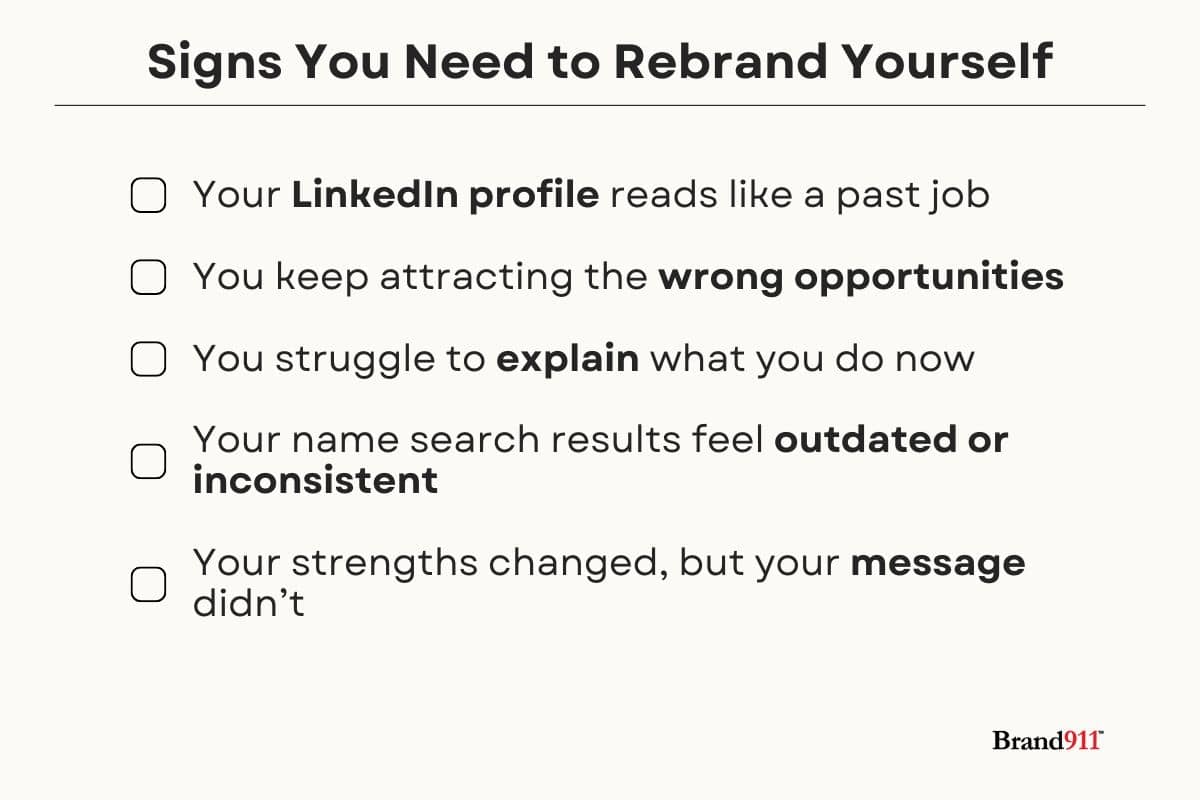
- Your LinkedIn profile reads like a role you no longer want
- You keep attracting opportunities that don’t fit your goals
- You struggle to clearly explain what you do now
- Your name search results show outdated or inconsistent information
- Your skills and strengths have evolved, but your message hasn’t
When these signs show up, your brand is creating friction instead of momentum.
5 Steps to Rebrand Yourself
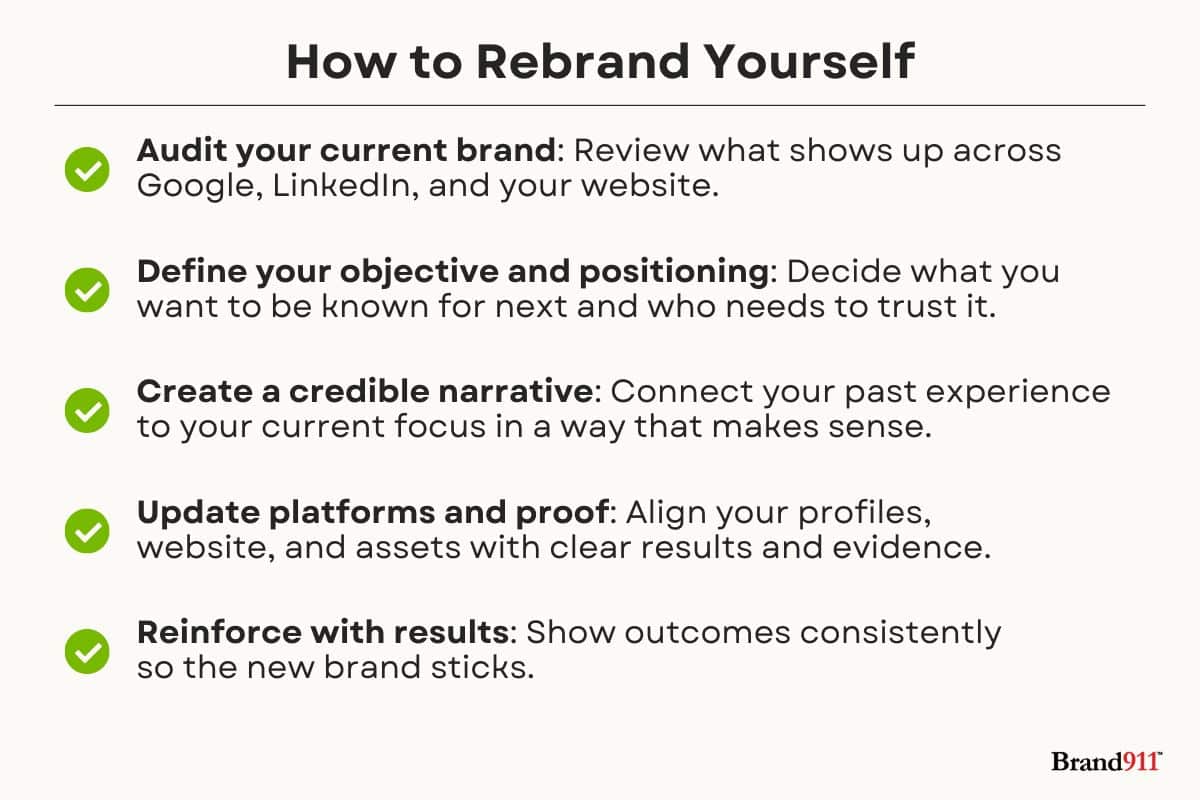
Step 1: Assess Your Current Brand Identity
Before you change anything, you need a clear picture of how you are currently perceived. Rebranding without this step leads to mixed messages and credibility gaps.
Run a Fast Brand Audit
Start by reviewing the places where people form first impressions. Focus on accuracy, consistency, and relevance. A structured personal brand audit helps you spot gaps before they turn into credibility issues.
- Google search results for your name
- LinkedIn headline, About section, and Featured content
- Your bio on a company website, board page, or speaker profile
- Old interviews, podcasts, articles, or guest posts
- Social media profiles you no longer use but still appear in search
Look for outdated titles, unclear positioning, or content that reflects a previous phase of your career.
Identify the Gap
Once you see what’s out there, compare it to where you are now and where you want to go next.
- What you do now
- What your online brand currently says you do
- What you want to be hired for next
That gap is the problem your rebrand needs to solve.
Step 2: Define Your New Objective and Brand Strategy
This is the step most people skip, and it’s why many rebrands fail. Without a clear objective and strategy, your updates feel scattered instead of intentional.
Clearly Define Your Objective
Start by naming the outcome you want. Vague goals create vague brands.
Common rebranding objectives include:
- A promotion or expanded role
- A career pivot into a new function or industry
- A niche shift within the same field
- A move into consulting or advisory work
- Increased executive visibility or thought leadership
Pick one primary objective. Your brand should point in a single direction.
Define Your Target Audience
Your brand is built for the people who need to trust you.
Ask yourself:
- Who needs to believe in your value
- What they need to understand about your role or expertise
- What proof they expect to see before they engage with you
- This keeps your messaging focused and prevents you from trying to appeal to everyone.
Write Your Positioning in Three Lines
Clear positioning makes your rebrand easier to execute across every platform. If your message feels fuzzy, it’s often because your core statement is unclear. Taking time to write a personal brand statement gives you language you can reuse everywhere.
Use this simple framework:
“I help [type of person or organization] solve [problem] by doing [your work/skill/role] supported by [experience/results/expertise]”
If you can’t write this in plain language, your personal brand strategy needs more clarity.
Step 3: Create a Coherent Narrative of Your Transformation
A rebrand succeeds or fails based on how well you explain the change. Without a clear narrative, people fill in the gaps themselves.
The Credibility Rule
Your rebrand should feel like a natural next step, not a sudden change. People should be able to see how your past experience connects to what you do now. When the story makes sense, your new positioning feels credible instead of forced.
The Bridge Story Framework
Use this structure to connect your past to where you are now.
- Where you were: Your previous role, focus, or area of expertise
- What you learned: Skills, insights, or experience that changed how you add value
- What you do now: Your current role, focus, or specialty
- What results you drive: Outcomes, improvements, or impact tied to your work
- Why it matters to your audience: How this evolution benefits the people you work with
This framework makes your rebrand feel intentional and earned.
What Not to Do
Avoid common mistakes that undermine trust.
- Over apologizing for your past experience
- Pretending your previous work didn’t happen
- Making the shift sound sudden or unexplained
- Talking about yourself without tying the story to outcomes
A clear narrative builds confidence and makes your new positioning easier to accept.
Step 4: Rebrand Your Online Presence
This is where many rebrands fall apart. If your platforms are inconsistent, people don’t know which version of you to trust.
Update the Platforms That Shape Trust
Start with the places that influence perception first.
- Google search results for your name
- Your personal website
- Company bio pages or board profiles
- Speaker pages, podcasts, and author bios
- Secondary social profiles that still appear in search
If you don’t control what appears when someone searches your name, your rebrand loses credibility before it starts. Knowing how to rank for your name is a critical part of shaping trust.
What to Update on Each Platform
Consistency matters more than perfection. Focus on these elements everywhere.
- Your headline and summary language
- Proof points and measurable results
- Visual consistency, including photos, banners, and tone
- Featured assets like case studies, interviews, or published content
If one platform tells a different story, it weakens the entire rebrand.
Your Website Is the Control Center
LinkedIn is a profile. Your website is the narrative.
It gives you full control over the message, proof, and search visibility tied to your name. Creating a strong personal website supports your rebrand even when social platforms change.
Core pages to include:
- About
- Proof, such as case studies, portfolio work, or wins
- Media or speaking
- Content hub
- Contact
Step 5: Introduce Your New Brand and Reinforce It With Proof
A rebrand only works if people recognize it and believe it. That happens through consistent signals and visible results.
Soft Launch vs Public Announcement
There are two effective ways to roll out a rebrand. Choose the one that fits your situation.
- Soft launch: Update your profiles, website, and messaging first. Let the new positioning spread naturally through conversations, search results, and ongoing work.
- Public announcement: Share one clear update about your new focus. Then support it with consistent content, proof, and output over time.
In both cases, follow-through matters more than the announcement itself.
How to Rebrand Yourself at Work
Internal perception shifts through behavior, not titles.
- Update how you introduce yourself in meetings and conversations
- Align with your manager on what you want to be known for
- Choose one high-visibility project that fits your new positioning
- Share wins internally before asking for a larger role or responsibility
Use simple, repeatable language:
- “I’m focused on X now because it drives Y.”
- “My strongest work lately has been around X.”
- “If you need help with X, I’m your person.”
These small cues reinforce your brand without forcing an announcement.
Show Accomplishments So People Believe the Shift
Proof turns intention into credibility.
- Case studies
- Before-and-after metrics
- Testimonials
- Talk titles or workshop topics
- Guest features or interviews
- A short content series that supports your new positioning
When people can see the results, the rebrand feels real and earned.
Common Rebranding Mistakes That Kill Momentum
Many rebrands fail not because the idea is wrong, but because execution is incomplete.
- Changing visuals without updating the message: New photos or colors won’t help if your positioning stays the same.
- Updating LinkedIn but ignoring Google results: If outdated pages still rank for your name, they undercut the rebrand.
- Saying “excited to announce” without proof: Announcements create skepticism when results don’t follow.
- Rebranding in private and hoping people notice: If you don’t signal the change, your audience won’t guess it.
- Trying to target everyone: Broad messaging weakens trust and makes your brand forgettable.
- Keeping outdated content live “just in case”: Old bios, posts, or interviews confuse people and stall momentum.
Avoiding these personal branding mistakes keeps your rebrand clear, credible, and forward-moving.
Maintaining Your Rebrand Without Constant Work
A successful rebrand does not require daily effort. It requires regular, intentional maintenance.
The Quarterly 30-Minute Audit
Set aside time once per quarter to make sure your brand still reflects your current value.
Review:
- Google search results for your name
- The top section of your LinkedIn profile
- Your website homepage and About page
- Featured proof assets like case studies or testimonials
- Any outdated bios still circulating online
This quick check prevents small inconsistencies from turning into bigger credibility issues.
What to Post to Keep the Brand Active
You don’t need to post constantly to reinforce your rebrand. Focus on content that supports your positioning.
- Lessons learned from your work
- Mini case studies that show outcomes
- Point-of-view posts related to your expertise
- Credibility markers like talks, features, or results
Consistent signals over time are what make your rebrand stick.
Take Control of Your Professional Narrative
Rebranding yourself is not about starting over.
It is about making sure your experience, message, and visibility all point in the same direction.
When done right, a rebrand removes confusion, builds trust faster, and puts you in control of how opportunities find you.
Key Takeaways
- Rebranding works when positioning, proof, and visibility align
- Clear objectives prevent scattered messaging
- A strong narrative connects your past to where you’re going next
- Proof matters more than announcements
- Consistency across search results, LinkedIn, and your website is what makes the rebrand last
If your current online presence no longer reflects your value, fixing it alone can be time-consuming and risky. Brand911’s personal branding services help professionals rebrand with clarity, credibility, and control.
FAQs About How to Rebrand Yourself
How long does it take to rebrand yourself?
Rebranding yourself usually takes a few months to take hold. Profile updates can happen quickly, but changing perception takes repeated signals. Most professionals see momentum once their messaging, proof, and visibility stay consistent over time.
Can you rebrand yourself in the same industry?
Yes. Many rebrands happen without changing industries. You might shift your niche, role, or focus while using the same experience. The key is changing what you are known for, not where you work.
How do you rebrand yourself at work?
Rebranding at work happens through actions, not announcements. Update how you introduce yourself, align with your manager on your focus, and take on visible work that supports the new direction. Sharing wins consistently helps others associate you with your new positioning.
What should you change first: LinkedIn or your website?
Start with LinkedIn, since it is often the first place people look. Your website should follow as the central source of truth that supports search results and proof. Both need to tell the same story for the rebrand to work.
How do you explain a career pivot without losing credibility?
Frame the change as growth, not a reset. Connect your past experience to what you do now and focus on outcomes you can deliver. A clear bridge story makes the shift feel intentional and earned.
How do you rebrand yourself if your Google results look outdated?
Audit the pages that rank for your name and update or replace them with current content. Publishing new, relevant pages helps push outdated results down over time. Consistent messaging across platforms reinforces the new brand.
What is the difference between a rebrand and a brand refresh?
A rebrand changes your positioning, audience, and narrative. A brand refresh updates how your existing brand looks or sounds without changing direction. If your goals have changed, you need a rebrand, not just a refresh.
About us and this blog
We are a digital marketing company with a focus on helping our customers achieve great results across several key areas.
Request a free quote
We offer professional SEO services that help websites increase their organic search score drastically in order to compete for the highest rankings even when it comes to highly competitive keywords.
Subscribe to our newsletter!
More from our blog
See all posts




Recent Posts
- What is an SEO Strategy? January 8, 2026
- What Is Digital PR? A Practical Guide to Building Trust Online January 6, 2026
- How to Do a Content Gap Analysis December 30, 2025


Recent Comments